Are you trying to figure out how voluntary deregistration works in Australia?
At Australian Business Magazine, we’ve researched the full process, from ASIC’s eligibility rules to what happens with your tax obligations once the doors shut. From what we’ve seen across Australian business exits, voluntary deregistration is often misunderstood as a shortcut rather than a formal legal process.
This guide cuts through the confusion. Here’s what we’ll cover:
- What voluntary deregistration is and who qualifies
- Lodging your application with ASIC, step by step
- A full checklist to work through before you close
- How this process differs from winding up
Ready? Let’s get into it.
What Is Voluntary Deregistration of a Company?
Simply put, voluntary deregistration is the formal procedure of removing a company from the ASIC register under section 601AA of the Corporations Act 2001. Once removed, the entity no longer exists in a legal sense. So it can’t sign contracts, hold property, or trade in any capacity.
Plus, this process isn’t the same as ASIC-initiated deregistration, where the regulator steps in after a company fails to meet its obligations (like unpaid annual fees or overdue lodgements). Closing voluntarily, by contrast, is a decision the directors and members make themselves.
Here, your business needs to meet a specific set of eligibility conditions first.
Who Can Apply for Voluntary Deregistration?

Not every company qualifies, and ASIC sets strict conditions that must be satisfied for an application to move forward. If those boxes aren’t all ticked, the regulator will reject the application and keep the fee.
Here’s what you need to clear.
The Company Has Stopped Trading
A company must have fully ceased all business activity for ASIC to consider a voluntary deregistration application. That means the company is:
- Free of any invoicing or billing activity
- Out of active contracts with clients or suppliers
- No longer employing or engaging any staff
- Holding assets worth less than $1,000 in total
That last point is a hard limit. So if there’s cash sitting in an account or equipment still on the books, deal with those ahead of lodging.
Beyond that, the business must carry no outstanding liabilities at the time of application. That covers unpaid wages, external debts, and any other financial obligations still carried at closure.
All Members Agree to Deregister
Directors must sign written resolutions confirming that all eligibility conditions are met prior to anyone deregistering. Every member needs to formally consent (and yes, that means all of them, not just a majority).
On top of that, all fees and penalties payable to ASIC must be cleared at the point of lodging, because any outstanding balance will block the application immediately. For this reason, you should check the ASIC portal and clear those amounts beforehand.
How to Apply for Voluntary Deregistration
The official way to start the process is lodging ASIC Form 6010 online or by mail, along with the $50 application fee. We’ll walk through each step below.
Lodge ASIC Form 6010
Lodging Form 6010 online is the quickest way to get your application in front of the regulator and avoid unnecessary delays. Once directors are satisfied that all conditions are met, they sign the form and submit it through the ASIC portal.
Fortunately, all supporting documents can be signed and lodged electronically. That means you don’t need to post anything unless you prefer the paper route.
Application Fees and Processing Times
As we already mentioned, it costs $50 to apply for company voluntary deregistration, and the regulator processes online applications about two to three months upon submission. That’s worth knowing if your annual review fee is coming up.
In fact, you should lodge at least two weeks ahead of the due date to avoid paying it. If your lodgement doesn’t reach ASIC in time, the full company’s annual review fee still applies, and you won’t get a refund on the application fee if they reject it.
Useful Tip: For paper submissions, allow up to a fortnight for processing, including postage time, because delays here can push you past that payment deadline. Submitting digitally is the safer bet.
What Happens After ASIC Approves Your Application
Approval doesn’t mean closure happens immediately. In practice, things roll out in stages.
First, ASIC updates the status to “Strike-Off Action in Progress” on the register. The regulator then publishes a notice on its Published Notices website, usually within two weeks of approval.
ASIC officially strikes the entity off two months after that notice goes live. So the full timeline from lodgement to closure typically runs 2 to 3 months. Plan around that, especially if there are remaining financial or legal loose ends to tie up.
What to Do Before You Deregister Your Company

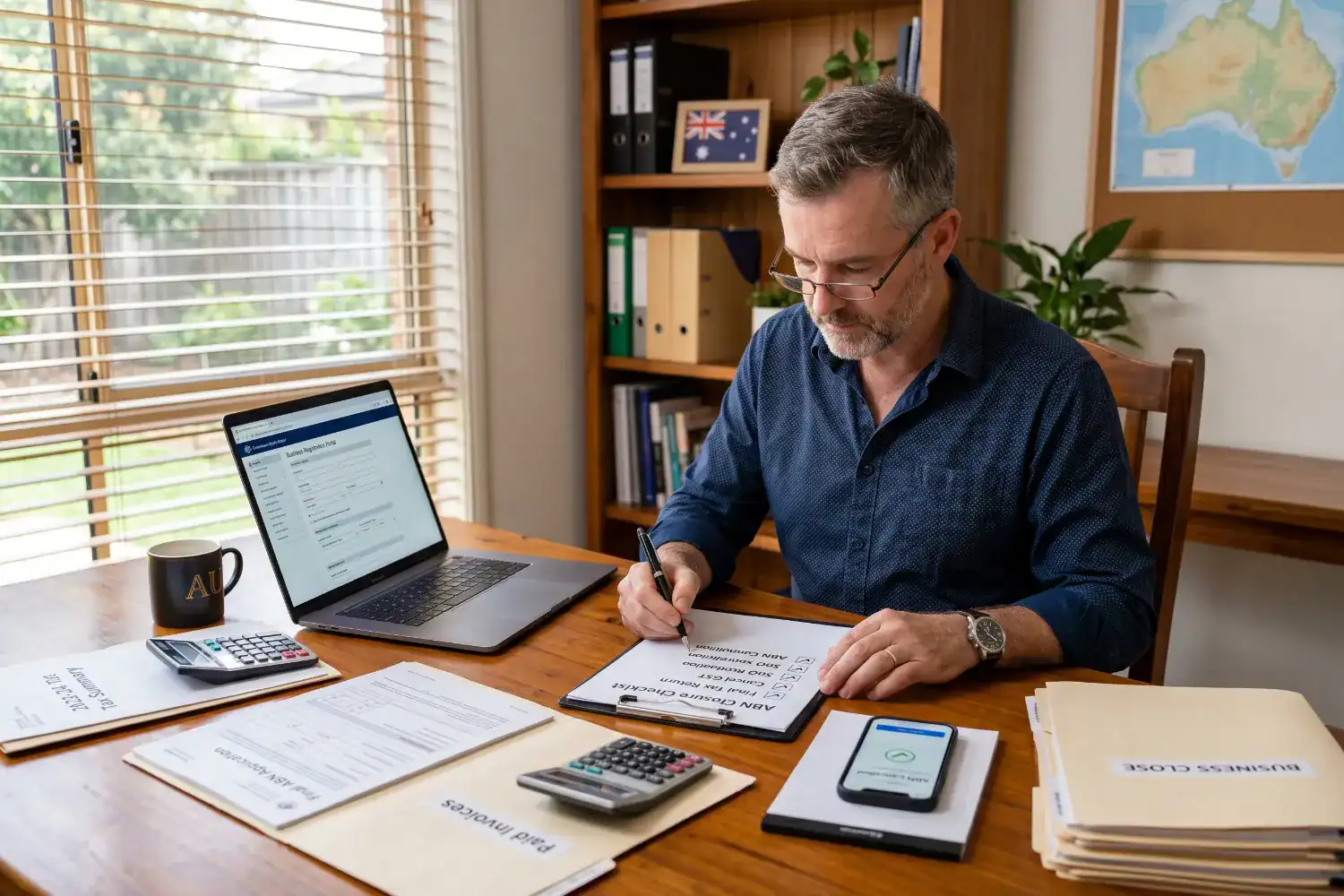
Ticking off every pre-closure step protects you from unexpected tax debts, forfeited assets, and rejected applications down the track. Our investigation into common mistakes found that cancelling ABN and tax registrations is the step most business owners overlook.
This checklist will help to make sure you’ve covered the same ground:
- Cancel Tax Registrations: Your ABN, GST, PAYG withholding, and FBT registrations don’t cancel automatically when your business closes. Sort these with the ATO early, as they’re treated as entirely separate obligations.
- Close All Bank Accounts: Every company bank account needs to reach a zero balance at the point of lodging. That means waiting for any final tax payments or refunds to clear fully first.
- Sort Out Company Names and Licences: Cancel or transfer any business names the company holds, along with any applicable licences or permits. Skip this step, and those registrations keep running up fees in the background.
- Lodge Final Tax Return: Confirm all BAS statements are up to date with the ATO at the same time. These need to be clean when you submit your application.
- Cancel Any Australian Financial Services Licence: The same goes for any credit licence the entity holds. Both must be cancelled with the relevant body first, well ahead of contacting ASIC.
- Trustee Companies Need Extra Steps: If the entity acts as a trustee, the trust must be wound up or transferred to a new trustee first. Nothing can proceed until that’s fully resolved.
- Hold Onto the Records: Under the Corporations Act 2001, directors in place at the time of closure must keep the company’s books for three years afterwards. If a liquidator was involved, that period extends to five years from the end of external administration. Don’t bin anything early.
Worth Noting: If your business has any credit amounts sitting on its ASIC account, sort those out before lodging Form 6010. The regulator expects a clean slate on both ends.
In short, getting this checklist right is what separates a smooth closure from one that drags on for months. And speaking of smooth, it’s worth knowing how voluntary deregistration actually stacks up against winding up.
How Does Voluntary Deregistration Differ from Winding Up?
Many business owners assume that closing a business and winding up are the same thing. But they’re two very different paths, and choosing the wrong one can cost you time and money.
The table below breaks down how the two options compare:
| Voluntary Deregistration (VL) | Members’ Voluntary Liquidation (MVL) | |
| Cost | $50 application fee | Significantly higher, and liquidator fees apply |
| Speed | Two to three months | Six to twelve months typically |
| Assets | Must be under $1,000 | No asset limit |
| Liquidator required | No | Yes |
| Best for | Simple, clean closures | Companies with meaningful assets or liabilities |
| Director control | Directors retain control throughout | Liquidator takes control |
Voluntary deregistration suits a business that has already wound down its affairs, settled every debt, and has nothing left to distribute. It’s a lower-cost, administrative path, but only if the business meets the strict eligibility criteria we covered earlier.
MVL, on the other hand, works better when the entity still holds assets worth distributing, carries unresolved liabilities, or has multiple stakeholders needing a clean, documented exit. MVL can also give access to capital gains tax concessions that the simpler path won’t. That’s worth flagging if the company holds property or investments.
Ultimately, the decision comes down to the financial position of the business. If the books are clean and assets are minimal, voluntary closure is the easier route. But if there’s anything meaningful left to resolve, get professional advice and consider MVL instead.
Can You Stop a Voluntary Deregistration?

Yes, stopping the process is possible, provided someone acts within the two-month notice period. This applies to both the applicant and any third party with a stake in the outcome.
Here’s how each situation works.
If You’re the Applicant
Changed your mind after lodging? Contact ASIC directly and explain why the process should not proceed. The regulator will review the request and respond in writing within 28 days, either confirming it will stop or explaining why it will continue.
Quick Tip: Keep the reasoning clear and factual, and attach any supporting evidence that backs the case. A well-documented request gives ASIC everything it needs to make a fast decision, which could save you weeks of back-and-forth.
If You’re a Third Party
Any third party can apply to the regulator to delay this process for an initial period of 30 days. The application must include the following:
- The entity’s name and ACN
- The grounds for stopping deregistration
- Your postal address
During that 30-day window, a further delay is possible if legal proceedings against the company have started or if there are firm plans to initiate them shortly. ASIC will hold off on closing the operation so those proceedings can run their course.
So if you’re a creditor who finds out a business is about to close, act fast. Once the two months are up and the company drops off the register, recovering any money owed becomes a much harder conversation.
Now, stopping deregistration is one thing. But what happens to your tax obligations once the business is actually gone?
What Happens to Your Tax Obligations After Deregistration?
Deregistering does not wipe your tax slate clean. After all, the ATO references debts to the entity’s ABN rather than its ASIC registration status. This means a Director Penalty Notice (DPN) for unpaid PAYG withholding, GST, or superannuation can still land in your letterbox long after the entity is gone.
For example, if the business carried unresolved super guarantee charges at closure, the ATO can pursue the former directors personally for that debt.
The safest move is to get a tax clearance certificate from the ATO early, well ahead of submitting your application. This confirms all tax affairs are finalised and gives you documented proof that nothing is outstanding.
If the business carries any history of unpaid debts, unresolved returns, or superannuation shortfalls, get professional advice prior to taking any further steps. A rushed exit can leave you personally exposed for years, and most former directors we’ve spoken to say the DPN was the last thing they expected after closing.
That’s exactly why we put together a full guide on closing a business in Australia, covering every step you need to properly wrap things up and protect yourself along the way.
What Happens to a Deregistered Company’s Assets?

Anything still held in the business’s name at the point of closure vests in ASIC or the Commonwealth automatically. That includes cash, property, equipment, and everything else the entity owned.
To avoid that outcome, distribute or dispose of everything before lodging. And if there’s anything of value remaining, sort it out first (because waiting until after approval is too late).
Beyond physical items, directors should also account for intellectual property, domain names, and outstanding fees (like unpaid invoices or client deposits) still owed. These are easy to overlook, but the regulator won’t make exceptions for them.
And what if something is discovered after the entity is already struck off? The only path forward is to reinstate it, recover what remains, distribute it properly, and then restart the whole process from scratch.
This is exactly the kind of setback you can sidestep with a careful audit.
Ready to Close Your Company the Right Way?
Now that you understand how voluntary deregistration works, the path forward is clearer than it might have seemed at the start. It’s a legitimate, well-structured process, only if every eligibility condition is met and every item below is ticked off ahead of time.
A quick recap before you take the next step:
- Confirm that all members agree and that every ASIC condition is satisfied
- Cancel your ABN, tax registrations, and any licences before lodging
- Lodge Form 6010 online and pay the $50 fee within 28 days
- Allow two to three months from application to full closure
If the business isn’t quite ready for voluntary deregistration, keeping it dormant is an option. But dormant entities still carry the same legal obligations under the Corporations Act, including annual review fees and ATO reporting, so it’s not a cost-free pause.
At the end of the day, closing a company this way is one of the cleaner ways to wrap up a chapter and move on. Get the checklist right, clear your tax position, and lodge with confidence.
For more practical guides on running, growing, and closing a business, head over to Australian Business Magazine. We publish straight-talking guides built around the challenges business owners actually deal with.
FAQs (Frequently Asked Questions)
Here are the most common questions we hear about the company deregistration process in Australia.
Can a Company Still Conducting Business Apply to Deregister?
No. Australian Securities and Investments Commission rules are clear on this point. A business must have fully ceased trading before any application for voluntary deregistration moves forward. If the entity is still conducting business in any capacity, ASIC will reject the application outright.
What Does “Ceased Trading” Actually Mean for Deregistration?
A company is considered to have ceased trading when it has stopped all commercial activity, closed its accounts, and holds no active contracts. Simply having no income isn’t enough. The legal requirements go further, covering outstanding liabilities, staff, and the condition that the company’s assets are worth less than $1,000 in total.
Do All Members Need to Agree Before You Can Deregister a Company?
Yes, unanimous consent is a firm legal requirement. Every member must formally agree before the company deregistration process can begin. If even one member withholds consent, the application can’t proceed. Directors then sign written resolutions to confirm all members are in agreement before anything gets lodged.
How Do I Check My Company’s Status After Lodging?
Once ASIC processes your application for voluntary deregistration, the company’s status updates to “Strike-Off Action in Progress” on the register. From there, ASIC issues a company compliance notice confirming the impending closure. You can track all details through the ASIC portal at any point during the process.
Is It Possible to Stop Voluntary Deregistration After Lodging?
Yes. To stop voluntary deregistration, contact ASIC directly within the two-month notice window and outline your reasons clearly. The regulator responds within 28 days. Third parties with legal proceedings underway can also apply separately to delay the process using the following steps outlined on the ASIC website.