Many people see headlines about economic growth and infrastructure projects, but they might not understand what this actually means for the future of Brisbane. If you’re trying to figure out where the city is headed, this guide will help.
The truth is, Brisbane’s economy is changing at a pace that affects everyone from small business owners to international investors.
And major projects are driving this shift. For example, government investment is redefining transport and urban capacity. At the same time, innovation is spreading across industries. And the city’s position in the Asia Pacific region is creating connections to the global business world.
It’s worth understanding how these changes create real opportunities.
Why Is Brisbane A Leading Business Hub In Australia?

Strong economic growth, major infrastructure investment, and diverse industries make Brisbane a leading business hub. The combination creates jobs across multiple sectors and attracts investment from both domestic and international sources.
As Australia’s third-largest city economy, it contributes approximately $200 billion to the national economy annually(mostly driven by construction, professional services, and international trade). Plus, its location along the Brisbane River supports one of the country’s busiest cargo ports that connects operators to Asia Pacific markets.
The growth isn’t slowing down, either. Queensland Treasury projects South East Queensland’s population will reach 6 million by 2046. That kind of demographic shift creates sustained demand for housing, retail, and services.
Basically, the scale is attracting attention. The city is becoming a global hub for companies in technology, finance, and logistics. Economic activity has even spread from the Central Company District (CBD) into the outer suburbs.
Meanwhile, the government is targeting transport capacity and urban development to handle the expansion in line with the Brisbane Economic Development Plan (which explains the construction activity everywhere).
What Key Statistics Show Brisbane’s Economic Growth?
Brisbane’s economic expansion shows up in population numbers, employment data, infrastructure investment, and economic output. These numbers show consistent growth across South East Queensland.
Here’s what the data tells us:
Brisbane’s Population Growth In South East Queensland
The city’s population growth is driven by interstate and overseas migration. Specifically, South East Queensland is expanding faster than most Australian regions. This broader trend is reflected in nearby Brisbane, with the Australian Bureau of Statistics reporting that the city added 58,200 residents in 2024-25(a 2.1% increase).
The contributors include:
- Net overseas migration – 33,900 people (the biggest driver)
- Natural increase – 13,200 people
- Net internal migration – 11,100 people
But development doesn’t spread evenly. The bulk of new housing and retail expansion is happening in western suburbs like Ripley in Ipswich, while the rest of Greater Brisbane sees slower growth in established areas. Northern areas like Morayfield are also expanding more quickly than established suburbs closer to the CBD. After all, cheaper land and more affordable housing push development outward where space is available.
Data From Queensland Treasury And ABS
According to Queensland Treasury, Queensland’s Gross State Product hit $510 billion in 2023-24. Meanwhile, Brisbane City Council reports that Greater Brisbane contributed approximately $225 billion to that total in 2022-23.
This concentration reflects Brisbane’s position as Queensland’s primary economic engine. That growth is spreading outward, with services, construction, and professional sectors driving development across the wider region.
Job Creation Trends Across Industries
The health care sector employs 455,900 workers across Queensland in 2023-24, making it the state’s largest employer. Construction follows with 278,600 workers. That’s high levels of employment growth concentrated in sectors tied to population expansion and ageing demographics.
Beyond these, logistics, professional services, and accommodation experienced a strong workforce expansion linked to infrastructure projects and visitor numbers. In short, the service economy is creating more opportunities than manufacturing or retail right now.
Infrastructure Investment And Development Pipeline
Infrastructure investment drives economic expansion through major projects that increase urban capacity and create construction jobs.
Queensland Government infrastructure spending includes major developments like:
- Cross River Rail
- Brisbane Metro
- Coomera Connector
- Airport Expansion
The Brisbane 2032 Olympic Games venue program adds billions more in committed funding. On top of that, construction activity is supporting business growth and adding urban capacity to handle the incoming population.
What Industries Drive Brisbane’s Future Economy?
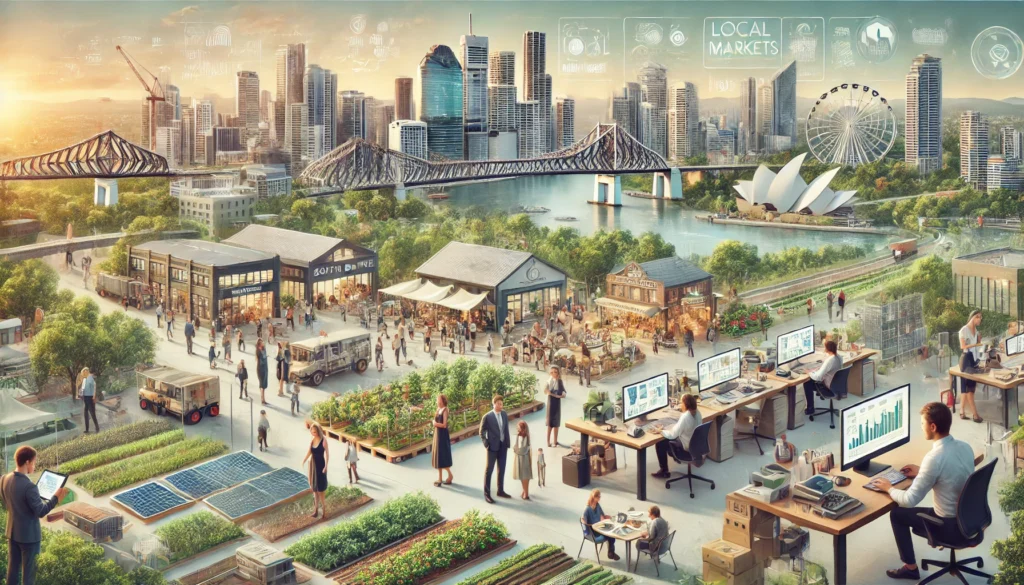
The main industries driving Brisbane’s future include manufacturing, healthcare, construction, tourism, logistics, and professional services.
If you’re wondering where the real opportunities are, we’ll cover each one here:
- Advanced Manufacturing: This industry generates approximately $20 billion in gross value added annually across Queensland and employs around 168,000 workers. Looking ahead, the State of the City Report forecasts 29% expansion over the next decade, driven by aerospace, defence equipment, and specialised industrial production.
- Healthcare and Life Sciences: Brisbane’s health and life sciences sector contributes more than $22 billion annually to the city’s $201 billion economy. World-class facilities and research institutions like QIMR Berghofer drive the expansion.
- Construction and Infrastructure: Non-residential building approvals hit a record $19.8 billion in 2023. From there, the Big Build program is driving large-scale projects worth $107 billion by 2027-28, focused on transport, energy, health, water, and education.
- Tourism and Events Economy: Brisbane delivered a record $13.7 billion in total visitor expenditure in 2024. The city captured 38% of Queensland’s domestic visitor numbers and 31% of visitor spending. Plus, business travellers contributed $526 million, with hospitality expanding 30% since 2020 (the fastest of any Australian capital).
- Logistics and Transport: The State of the City Report forecasts that transport and logistics will grow 43% over the next decade. Because the Port of Brisbane and distribution centres are connecting more Queensland operators to Asia Pacific buyers, and that’s only going to increase as the population expands.
- Business and Professional Services: Professional services make up eight of the top ten fastest-growing roles in inner Brisbane, reflecting the city’s evolving business culture. Specifically, finance jobs grew at double the rate of other capital over five years. So the knowledge economy forecast of 50% expansion makes sense when you look at where hiring is heading.
But industries don’t operate in isolation. The way they interact and evolve over the next decade will alter the city’s entire economy.
How Will Brisbane’s Economy Change In The Next Decade?
The economy will change through population growth, major infrastructure projects, and increased international business activity. Along with that, government support programs are changing how the city operates and where opportunities emerge.
Let’s break down what’s actually changing:
Population Growth Across Greater Brisbane
Greater Brisbane will add more residents over the coming decades, mainly concentrated in outer suburbs where development is still affordable. For many businesses, that creates immediate hiring opportunities in construction and services. But long-term expansion needs sustained investment in roads, schools, and workforce training to support the incoming population.
The development isn’t staying in the CBD either. North suburbs and western areas show the biggest increases because that’s where affordable land still exists.
Cross River Rail Project And Infrastructure Development
With population creating demand, infrastructure projects like Cross River Rail are reconfiguring how the city moves people and where business activity concentrates.
The project will add 10.2 kilometres of track. It connects the CBD, South Bank, Woolloongabba, and southern suburbs in ways the current system can’t handle (just ask anyone commuting from the south). So in practice, better transport opens up areas that used to be too far from jobs.
Brisbane CBD Growth And International Business Activity
Based on our observations at Australian Business Magazine, the CBD is attracting international investment in commercial property, technology, andprofessional services. Part of it is that companies expanding across the region see it as their natural entry point.
And the city has a few things working for it. For starters, trade agreements reduce barriers for companies doing cross-border business. Plus, direct flights to Asia mean executives can reach major markets in under ten hours instead of connecting through Sydney or Singapore. Meanwhile, the 2032 Olympic Games are strengthening the city’s position as a business hub that can compete with Sydney and Melbourne.
Brisbane City Council Strategy And Government Support
Government support programs provide companies with access to funding, tax incentives, and development assistance that wouldn’t be available through private-sector sources alone.
For instance, the Council’s 2032 Olympic and Paralympic Games Venue Master Plan puts money into:
- Urban renewal
- Transport upgrades
- Business precinct development
On top of that, Queensland Government programs add grants and tax incentives to encourage expansion and innovation. This builds confidence and opens funding that small operators wouldn’t get from banks.
What Are Opportunities And Risks For Brisbane Businesses?
Brisbane’s commercial sectors are looking at growth opportunities and real challenges at the same time, and you’ll see both sides in this section.
Table: Brisbane Business Opportunities Vs Risks
| Opportunities | Risks |
| Strong Economic Growth Across Sectors | Rising Costs And Inflation |
| Expansion In South East Queensland | Skills Shortages |
| Government Support And Investment | Policy Changes |
| Global Business Connections | Sustainability Pressures |
These don’t affect every operator the same way. Strong economic growth benefits construction, healthcare, and professional services through sustained demand. Meanwhile, rising costs hit small businesses harder through increased wages, rent, and operating expenses (the numbers don’t lie on this one).
Beyond the CBD, regional expansion creates opportunities for retail, hospitality, and local businesses in outer suburbs. But skills shortages limit workforce availability in trades, technology, and healthcare sectors where qualified workers are increasingly difficult to find.
There’s help available, though. Government investment programs support infrastructure and business development across the state. However, sometimes policy changes around taxation, planning, and environmental regulation create uncertainty for long-term planning that companies rely on.
For firms looking beyond Australia, global connections enable export growth and foreign investment for companies that can compete internationally. On the flip side, sustainability pressures require organisations to adopt green practices, increase energy efficiency, and meet environmental compliance standards (and those upgrades cost money). The purchasing power to make those changes varies wildly depending on the company’s scale.
How Is Innovation Shaping Brisbane’s Business Future?
Innovation is reinventing Brisbane’s business future through startup ecosystem development, AI data, and research collaboration. The city’s also seeing rapid change through quantum computing investment and digital infrastructure upgrades.
The innovations breaking through right now include:
- Startup Ecosystem and Local Business Innovation: Our investigation demonstrated that the city’s startup ecosystem supports 2,400 technology companies through coworking spaces, accelerator programs, and venture capital networks. River City Labs and The Capital even provide mentorship, funding connections, and a collaborative culture that help local businesses scale up beyond what they could manage alone.
- AI and Data Analytics Driving Digital Transformation: Artificial intelligence and data analytics are changing business operations across finance, healthcare, and logistics sectors. Beyond the headlines, companies are adopting machine learning, automation, and predictive systems to improve productivity and decision-making. These data insights help businesses spot patterns they’d miss manually.
- Research and Education Collaboration: University of Queensland, Queensland University of Technology, and Griffith University partner with industry on research projects. They’re developing commercial applications in medicine, engineering, and environmental science through partnerships with companies like Sanofi, Arup, and Rio Tinto that create job opportunities while solving real-world problems.
- Quantum Computing and Advanced Technology Growth: Queensland invested $940 million AUD in quantum technology through PsiQuantum’s Brisbane facility. That positions the city as a global centre for quantum computing research, software development, and high-tech manufacturing (industries that barely existed here a decade ago).
- Digital Infrastructure and Urban Technology Systems: Brisbane City Council is implementing smart city technology, including traffic management systems, digital connectivity upgrades, and data platforms. These improve urban services, reduce congestion, and support business efficiency across the metro area.
Technology alone won’t determine which businesses succeed. The bigger picture includes how people actually live, work, and spend their time across the city.
What Business Trends Are Building Brisbane’s Future?
Now that we’ve covered the major industries and innovations, let’s look at the specific trends changing how Brisbane does business.
Nighttime Economy Growth In Brisbane CBD
The CBD’s nighttime economy expanded through extended trading hours, live music venues, and cultural events that attract visitors after dark.
For example, retail, bars, and entertainment businesses benefit from increased foot traffic and consumer spending after business hours. Plus, major venues like South Bank and Fortitude Valley are drawing crowds most nights of the week now (which would’ve been unheard of a decade back).
Sustainability And Green Development In Brisbane
Developers now adopt green building standards, renewable energy, and waste reduction as standard practice in commercial and residential development. The 2032 Olympic Games sustainability requirements andQueensland’s renewable energy targets are forcing the shift. Adding to that pressure, Government regulations require energy efficiency targets.
What’s more, consumer expectations drive demand for sustainable products and environmentally responsible business operations. Simply put, companies that ignore sustainability are losing contracts and customers.
Expansion Of Retail Services And Tourism
What’s driving retail and tourism growth in Brisbane? What we see is major events, cultural attractions, and new entertainment precincts bringing more visitors and consumer spending.
Looking at the sectors, retail and tourism continue expanding through major events, cultural attractions, and improved facilities. The standouts are Queen’s Wharf and the South Bank entertainment precinct.
You’ll see three main drivers:
- Convention activity brings in steady business visitors
- Sporting events draw weekend crowds
- Leisure travel keeps accommodation businesses busy year-round
Did you know? Business travellers alone contributed $526 million in recent visitor spending. Yes, that’s true. And the sector even keeps expanding as venues improve and events multiply.
Changing Population And Lifestyle Trends
Population changes are influencing business demand through demographic shifts, remote work adoption, and changing preferences (for urban living and service delivery).
The impact shows up everywhere. Flexible work arrangements mean people shop at different times and in different locations than they did five years ago. Technology accelerates the shift. Online services and lifestyle-focused retail are renewing commercial property use and service delivery across the city.
At the end of the day, these trends create openings for businesses that can adapt. Specifically, small businesses benefit most because they can pivot quickly when markets shift.
How Can Small Businesses Prepare For Brisbane’s Future?
Small businesses can prepare by adopting digital technology and training their workforce. They also need to embrace sustainable practices and plan strategic capital allocation that positions them for expansion in Brisbane’s growing economy.
If you have a small business, follow these steps to get ready:
- Digital Transformation and Technology Adoption: Small operators should adopt digital tools, including online sales platforms, customer relationship management systems, and automation software. These improve efficiency, reach new customers, and help compete with larger organisations that already have these systems in place.
- Workforce Upskilling And Job Creation: Training programs, apprenticeships, and professional development help address skills shortages and improve productivity. They also retain employees in competitive labour markets where finding qualified workers grows increasingly difficult. Honestly, putting resources into your team pays off when good workers are hard to replace.
- Sustainability and Long-Term Strategy: Adopting sustainable practices helps meet regulatory requirements and reduce operating costs. It also appeals to environmentally conscious consumers and corporate clients who keep an eye on supplier practices. In short, sustainability isn’t optional anymore.
- Capital Allocation and Market Expansion: Strategic capital allocation in equipment, technology, and market development positions businesses for expansion as the city’s economy expands. There are opportunities in emerging sectors, regional markets, and export-oriented industries. And companies that commit resources now in the right areas will be competing globally within a few years.
Frankly, the future looks different for every business. That’s why your preparation today determines which opportunities you can actually take tomorrow.
Brisbane’s Economic Outlook
The city’s economy will continue growing through infrastructure investment, population expansion, and industry diversification across South East Queensland.
Businesses that adopt technology, develop workforce skills, and plan for sustainability will be best positioned to benefit from economic expansion and changing market conditions. Government support and major projects are opening doors across multiple sectors. So manufacturing, healthcare, construction, tourism, and professional services all have room to expand.
The future belongs to businesses that can adapt to shifting trends while building on Brisbane’s strengths. And if you want more insights on Australian business trends and opportunities, keep reading Australian Business Magazine.