
Andrew Barnes didn’t set out to build a billion-dollar company. He just wanted to fix a problem he kept running into: workplace training was scattered, clunky, and hard to manage.
That frustration, shared with three friends, became the goal for Go1. Barnes and his co-founders founded the company in 2015, and it grew into a workplace learning platform that now serves more than 10,000 organisations.
Here at Australian Business Magazine, we’re breaking down exactly how that happened. You’ll find:
- How four friends turned a shared frustration into Go1
- The early setbacks that influenced how the founders built the company
- The funding rounds that pushed Go1 toward unicorn status
- Why Andrew Barnes stepped back from the CEO role
- What he’s focused on now
Before the funding rounds and milestones, let’s learn more about the founder himself.
Who Is Andrew Barnes?
Andrew Barnes is the Brisbane entrepreneur who co-founded Go1, a company built around workplace training and skills development.
As a teenager, Barnes was already tinkering with code and taking on paid software work long before Go1 existed. His path then took a more academic turn: he studied economics at university, ahead of a move overseas.
Barnes received a Rhodes Scholarship to study at Oxford, where his master’s focused on learning and technology. He then returned to Australia and added a PhD in business strategy from the University of Queensland. That kind of formal training spanned both sides of what Go1 does: the learning content and the business behind it.
It also set him up well for the job that came next. Barnes served as Go1’s CEO for almost a decade before he stepped back from the role in 2024.
How Did Andrew Barnes and His Co-Founders Start Go1?
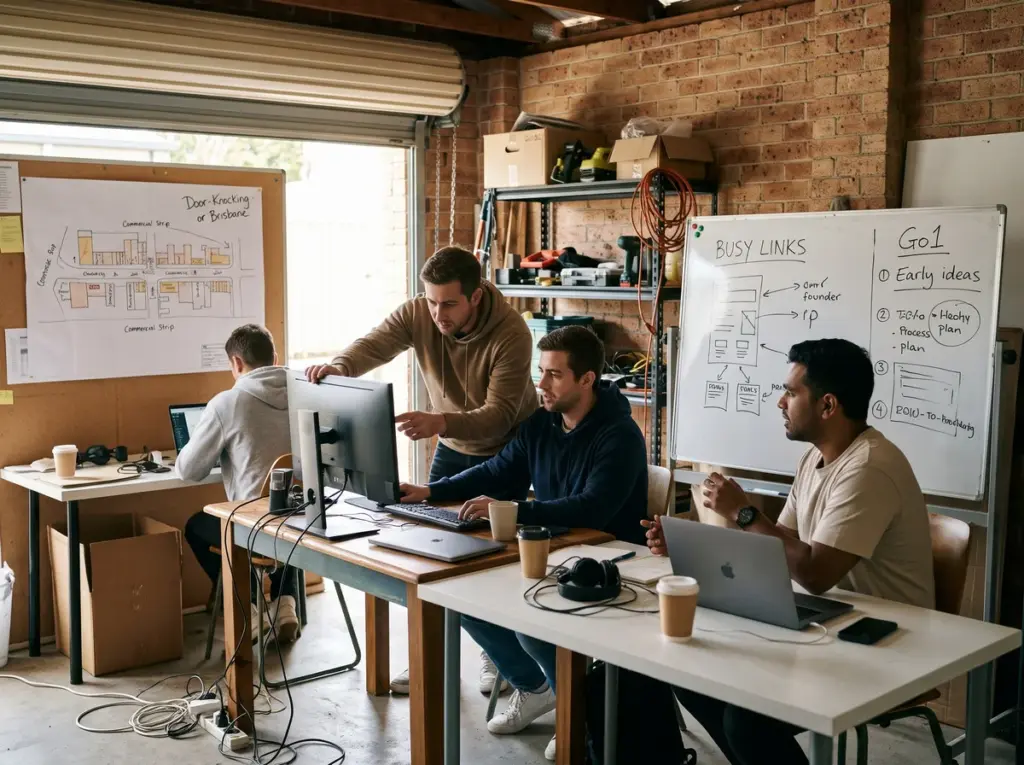
Four friends, one shared idea, and a garage in Logan. That’s the short version of how Go1 began. Here’s the longer one:
Four Founders With Different Skills
Andrew Barnes, Vu Tran, Chris Eigeland, and Chris Hood each brought something different to the founding team.
Barnes and Tran met in high school and stayed close for years afterwards. The pair built websites together as teenagers, long before Go1 was ever an idea. Eigeland came from outside that school circle. He joined their web-building venture a little later, bringing sales and client-facing skills the other two lacked.
Hood joined the group after meeting Barnes at a tech conference, years after the other three had already been working together. He brought formal software engineering training that complemented the hands-on coding skills Barnes and Tran had already picked up. Eventually, Hood became Go1’s chief technology officer.
School Friends Behind Busy Links
Barnes and Tran started Busy Links in 2006, an early Tripadvisor-style idea for reviewing local businesses. The timing worked against them, though. Barnes later said the idea faced a difficult market because many businesses were still a long way from having their own websites.
With no customers, the pair tried something drastic. They found Brisbane’s longest commercial strip and went door-knocking. One visit produced their first customer, who hired them to build a website. That customer referred them to others, but it was a slow, uneven start, nothing like an overnight success.
Ultimately, Busy Links unfolded. The original review-platform idea did not become a successful business, but the shift into building websites for other businesses gave them a direction worth sticking with.
From Client Projects to Founding Go1
The two school friends later worked on paid software projects and created websites for companies including ANZ Bank and News Corp. Eigeland joined them on that same client work, and the arrangement continued for a few years.
Client work paid the bills, but it wasn’t quite the same as running something of their own. By 2015, all four had come together, ready to put their combined skills into one company instead of someone else’s projects.
What Problem Was Go1 Built to Solve for Workplace Training?
Businesses have long dealt with a training problem, and content is usually the reason why. It often sits scattered across separate providers, which leaves staff with no single place to find what they actually need.
Take a typical company’s setup, for example. Compliance courses might sit in one system, onboarding material in a different one, and skills training in yet another altogether. For a manager trying to build a proper training plan, that often meant juggling several tools just to cover the basics.
Go1 set out to fix that mess. Instead of forcing companies to manage multiple providers separately, it gathered workplace learning content into one accessible platform. Employees got a single place to search, learn, and track their progress.
Fixing all that took more than a good idea, though. It took the right timing, the right people, and one program that gave Go1 its first shot at scaling up.
How Did Y Combinator Help The Founders Get Go1 Off the Ground?

Y Combinator is a US startup accelerator that invests in early-stage companies in exchange for equity. The program pairs each one with mentors and a global network of founders.
Getting in is famously competitive, and it played a direct role in Go1’s early growth. Let’s see how:
A Last-Minute Application in 2015
Barnes and his co-founders submitted their Y Combinator application close to the deadline, leaving little room to fix mistakes. Go1 still made it into the Summer 2015 cohort.
The acceptance came with real funding: US$120,000 in seed money for 7% equity. The program also brought founders together for a three-month accelerator experience in Mountain View, California, doing hands-on business building and workshops.
What the Program Gave Go1 Beyond Cash
Y Combinator connected Go1 with mentors, investors, and a global network of founders building their own startups. Its alumni community includes companies such as Airbnb, Dropbox, and Stripe.
That network gave founders warm introductions to later-stage investors. It also meant direct access to founders who’d already handled the same early hurdles, including hiring a first team to closing a first paying customer.
Why Andrew Barnes Compares Go1 to Airbnb
Andrew Barnes has compared Go1’s model to Airbnb, and the comparison fits well once you see how the platform actually works.
Go1 doesn’t create its own training courses. Instead, it curates content from outside providers and puts it all in one place. That approach let Go1 grow fast, since it never had to build every course from scratch.
The platform now partners with more than 250 content providers and covers areas like compliance, onboarding, and leadership development. Companies can access a wider learning library through one platform rather than managing multiple sources separately.
Go1 also plugs directly into tools businesses already use, including Microsoft Teams and Viva Learning. These connections help employees access training through systems their organisations already use.
Building a marketplace like that doesn’t come cheap, though. Turning Go1 into a genuine global player took several rounds of serious investment.
How Did Barnes Raise Funding to Expand Go1 Internationally?
As we already mentioned, Go1’s first external funding came from Y Combinator in 2015. After that, the company raised several larger rounds as it expanded internationally and built out its workplace learning marketplace.
Take a look at how that funding history developed over time:
| Year | Funding Event | Amount | Approx. Valuation |
| 2015 | Seed (Y Combinator) | US$120,000 | Not disclosed |
| 2018 | Series A (SEEK-led) | US$7.2 million | Not disclosed |
| 2019 | Series B (SEEK-led) | US$21.3 million | Not disclosed |
| 2020 | Series C (Madrona and SEEK-led) | US$40 million | Not disclosed |
| 2021 | Series D (SoftBank-led) | US$200 million | Over US$1 billion |
| 2022 | Latest funding round | Over US$100 million | Over US$2 billion |
| 2023 | Additional equity investment | US$30 million | Not disclosed |
We’ve covered a fair few Australian funding stories at Australian Business Magazine, and few follow this same gradual climb across seven separate rounds. That consistency is exactly what carried Go1 far past its Brisbane beginnings.
The 2021 round stood out from the rest, though. It made Go1 Brisbane’s first unicorn, a title no other company from the city had claimed before. By 2022, backers included AirTree Ventures, Five Sigma, Salesforce Ventures, Madrona and SoftBank Vision Fund 2, alongside other investors.
Go1 also grew through acquisitions. In 2023, it acquired Blinkist, a German app offering short book summaries in text and audio. Around the same time, Go1 announced a separate US$30 million equity investment from Insight Partners. The acquisition added a new format to Go1’s existing library.
A billion-dollar valuation changes how people see a company, and running it was about to look very different too.
Why Did Andrew Barnes and Co-Founder Chris Eigeland Share the CEO Role?

Running a company worth billions takes more than one set of hands. By 2021, Go1 had grown large enough that its leadership structure shifted to a dual-CEO model. And both of them played a part in how that unfolded.
Chris Eigeland’s Path From Chief Revenue Officer to Co-CEO
Chris Eigeland joined the company years earlier as chief revenue officer. He spent that time leading sales, marketing, and customer teams. That hands-on experience gave him a close view of how Go1 actually operated day-to-day.
In 2021, Eigeland stepped up to co-CEO alongside Barnes and shared responsibility for Go1 as it expanded its global customer base and scaled operations. He’d taken over direct oversight of the executive team entirely by late 2023.
Andrew Barnes Stepping Back in 2024
Go1’s growing workload eventually led to a bigger change. Barnes stepped down as co-CEO in 2024, closing out nearly ten years running the company.
In our experience covering founder exits, a clean, mutually agreed handover like this one is rarer than people assume. That clarity came from Barnes having a clear reason for the change. He said moving to a single CEO structure would help Go1 make decisions faster. He shared the news in a LinkedIn post, calling the decade of building Go1 “undeniably a marathon” that had “also gone by in the blink of an eye.”
Nearly a decade of running Go1 wasn’t the end of Barnes’ story, though. It just marked the start of a very different chapter.
What Is Andrew Barnes Doing Since Leaving Go1’s CEO Role?
Stepping back from Go1 didn’t mean stepping away from business entirely. Barnes had a new venture ready within months.
In October 2024, Barnes teamed up with Vu Tran and Gopi Sara to launch OneMRI, a startup built around whole-body MRI scans. The goal is early detection across more than 500 potential conditions, including solid tumours and brain aneurysms (the kind of screening most people only think about after a scare, not before one).
To be honest, the industry looks nothing like workplace learning on the surface. But the underlying pattern is familiar: spot a real problem, then build the technology to solve it.
And Barnes hasn’t walked away from Go1 either. He still sits on the company’s board as a director, while Chris Eigeland handles daily operations as sole CEO.
What Have Andrew Barnes and His Co-Founders Built Go1 Into Today?

Go1 looks nothing like the four-person team that started it all. As of 2024, the company employed close to 600 staff across 19 countries, including the US and UK.
And the reach goes well beyond headcount. More than 10,000 organisations use Go1, with over 50 million learners logging in worldwide. That’s a genuine global community, grown from a platform that once served a handful of Australian businesses.
In that same LinkedIn post we mentioned earlier, Barnes said learners complete a course or resource on Go1 roughly three times every second, a sign of just how much daily demand the platform now carries.
The company kept moving fast after Barnes’ handover, too. In 2026, it announced a new product direction built around contextual learning, which it delivers through integrations with tools such as Slack and Microsoft Teams.
From four friends in Logan to a platform used worldwide, Go1’s growth says plenty about where workplace training is headed next.
Go1 Was Just the Beginning for Andrew Barnes
Andrew Barnes spent almost a decade building Go1 into a platform millions of people use. Then he walked away from the CEO title to chase a completely different problem entirely. That’s not a common move, and it says something about how he thinks about business.
At ABmag, we keep tracking founders like Barnes, the ones who build something big, then start again from scratch. His path from a Logan garage to a US$3 billion company, and now to whole-body MRI scans, is proof that one good idea rarely stays the only one.
Want more founder stories like this? Explore ABmag’s full collection of Australian entrepreneur profiles for more journeys worth reading.
Frequently Asked Questions
These are some of the questions we hear most often about Andrew Barnes and Go1’s journey.
What Kind of Education Does Andrew Barnes Have?
Andrew Barnes studied economics before earning a Rhodes Scholar place at Oxford, focusing on learning and technology. He later added a PhD in business strategy from the University of Queensland, giving him a strong academic foundation before building Go1.
Where Does Go1 Support Customers Outside Australia?
Go1 expanded well beyond its Brisbane roots, building a global office footprint across 13 locations, including the US, South Africa, Vietnam, the UK, and Malaysia. The international footprint helped Go1 reach Asia Pacific markets and grow its global workforce alongside its learner base.
Is Go1 Only for Large Companies?
No. Go1’s online learning platform suits businesses of any size, even those spending a small amount on training. Small teams can access the same course library as larger organisations, without needing separate systems for compliance, onboarding, or skills training.
What Excites Andrew Barnes About OneMRI?
Barnes seems genuinely passionate about early detection technology. OneMRI addresses a different challenge than Go1 ever did, focused on health rather than the workforce. The startup screens for more than 500 potential conditions using whole-body MRI scans.
Did Andrew Barnes Ever Get Anything Wrong While Building Go1?
Every founder hits rough patches, and Barnes was no exception. Busy Links, his first venture with Vu Tran, folded after launching too early for most local businesses. That early misstep shaped how he approached Go1 years later.
What’s Next for Andrew Barnes and Go1?
Go1 continues addressing the future of workplace learning, with new conversations around contextual, in-the-moment training. For Barnes personally, the pace hasn’t slowed either; OneMRI keeps him just as relevant to a fast-changing industry as Go1 once was.
Do Companies Need Dedicated Learning Days to Use Go1?
Not necessarily. Some organisations set aside dedicated learning days each year, while others let employees dip into Go1 whenever it fits their schedule. Go1’s current approach focuses on bringing learning into employees’ daily workflows rather than treating training as a separate activity.