Australia’s creative industry is in the middle of a fight it didn’t start. AI-generated art is flooding social media feeds, cutting freelance incomes, and forcing small businesses to choose sides.
At Australian Business Magazine, we’ve spent years reporting on the issues and challenges Australian small businesses face. As AI tools become more common, the balance between technology and human creativity has become an important topic for business owners. We’ve explored both sides to help you understand what it means for your business.
In this article, we’ll look at who’s affected and how small businesses are responding. We’ll also cover what the Stop AI Theft campaign is demanding and how the government has responded so far.
It’s a lot to unpack, so let’s get into it.
What Is the AI Art Backlash in Australia About?
The AI art backlash in Australia is a growing community pushback against AI-generated images replacing human creative work without consent or compensation. It’s been building for a while, but 2026 is the year it’s finally hitting a boiling point.
Small businesses, freelancers, and artists are done watching their livelihoods get quietly undercut by tools that didn’t ask permission to learn from their work.
Several concerns are behind the growing tension within Australia’s creative community:
- The AI Flood on Social Media Posts: If you scroll through almost any local business feed, you’ll notice a familiar pattern. Many images share the same lighting, faces and polished look. AI-generated visuals are becoming increasingly common, which makes it harder to tell one small business apart from another.
- Who Is Affected: Graphic designers, freelance illustrators, voice actors, Indigenous artists and journalists are all facing growing pressure on their income. Artificial Intelligence platforms now complete tasks in seconds that once took these professionals hours.
- Why It Took Off So Fast: Many AI tools used by Australian small businesses are free or relatively inexpensive. Their low cost and ease of use have encouraged wider adoption, even as artists raise concerns about consent and compensation. Most require little technical skill or training, so users can start creating content within minutes.
- What “AI Theft” Actually Means: When generative AI models produce images, they rely on patterns learned from billions of images collected online. These datasets often include copyrighted artwork used without the creators’ knowledge, consent or compensation.
- Why Small Businesses Are Now Taking a Stand: Customer trust is also changing as Australians grow more wary of brands that use AI-generated content. In response, more small business owners feel pressure to publicly explain their stance on AI.
The debate raises a serious question about who bears the cost when AI operates without clear rules. Right now, much of that burden falls on the creators whose work helped train these tools, often without their consent or compensation.
How Has AI Art Damaged Australia’s Creative Industry?
AI art has affected Australia’s creative industry, with freelancers losing income and artists facing competition from AI-generated work. Voice cloning, copied journalism, and fake Indigenous artwork have added to these concerns. Across Australia, creative professionals are losing work to AI systems trained partly on their own creative output.
The impact is especially clear among these creative professionals.
Freelancers Losing Commercial Work to AI Platforms
AI platforms are taking over some of the commercial work that freelance designers and illustrators once relied on for income. Clients who previously hired local artists for social media graphics, event posters or product visuals now use AI tools to create them in seconds at little cost.
One Brisbane-based graphic designer told us she lost four regular clients in six months after they switched to Midjourney for social media graphics. The work she used to charge $200 to $400 per batch now costs those clients nothing beyond their AI subscription.
The final result isn’t necessarily better, but it’s cheaper. For many businesses, the lower cost is enough to make AI the preferred choice.
Voice Actors and Journalists Targeted by AI Systems
AI systems have targeted Australian voice actors and journalists by cloning their work and republishing it without credit or payment. A group of Australian voice actors discovered their recorded audio had been cloned and fed into AI tools without their knowledge (imagine having to prove a voice is yours).
Journalists have faced similar challenges as AI platforms use published news content to generate summaries. A January 2026 University of Sydney report found that Microsoft Copilot consistently favoured international news outlets over Australian sources. Only around one in five responses included links to Australian media.
Fake Indigenous Art Sold Through AI Image Generation
The sale of AI-generated imitations of Indigenous artwork raises serious cultural concerns in Australia. Aboriginal art carries deep spiritual meaning and reflects cultural knowledge, traditions and community connections that AI systems can’t genuinely reproduce.
Yet AI image tools are producing imitations of Indigenous artwork for sale online, which raises concerns about cultural misuse and lost income.
The Australian Government established the Aboriginal and Torres Strait Islander Expert Working Group on Indigenous Cultural and Intellectual Property in early 2025. The group was tasked with guiding new legislation to protect First Nations cultural rights. Its formation followed the first public consultation on the proposed legislation, which closed on 30 June 2024.
What Are Small Businesses Actually Doing About It?
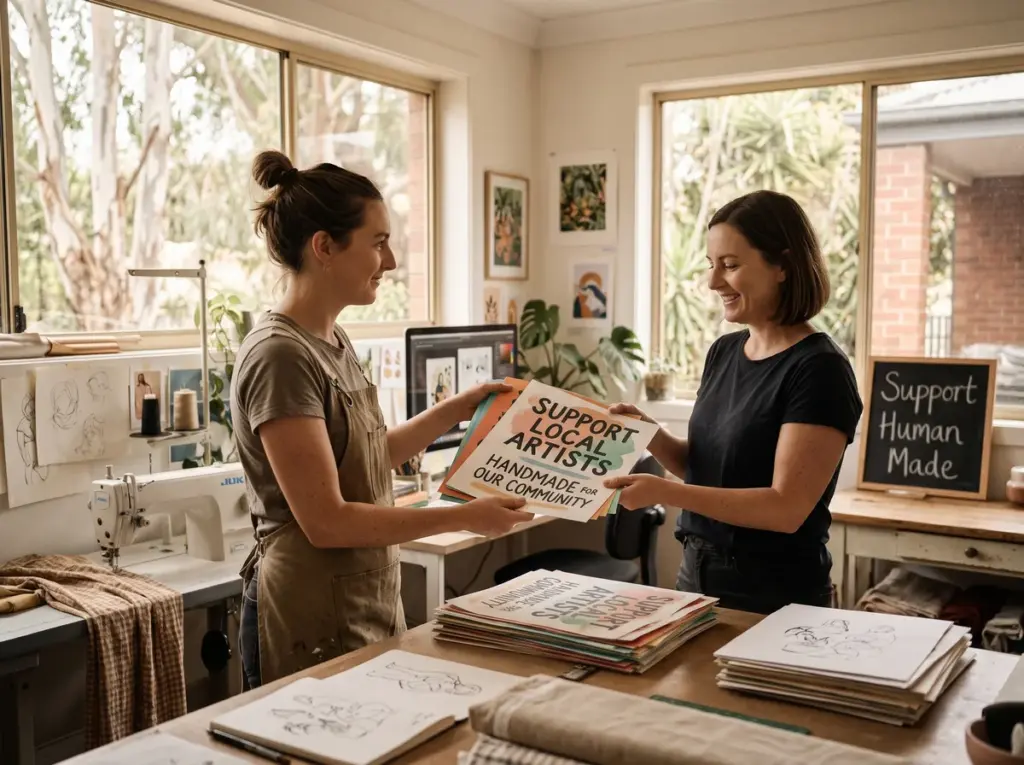
Small businesses are responding with public AI policies, apologies, support for human artists and calls for industry-wide bans on AI-generated content. Across Australia, hundreds of business owners are making their own decisions about AI use.
The pushback against AI-generated content is taking several forms.
Publishing AI Policies and Apologising Publicly
When Toowoomba wine bar and bookshop The Book Pour posted AI-generated flyers, a single phone call from an author changed everything. Owner Taylor Hailes hadn’t fully understood how generative AI systems are trained on scraped creative work.
Once she did, the response was immediate. The Book Pour published a public apology on Instagram and introduced a formal AI policy stating that AI has no place in the creative industry.
Policy Consideration: Your AI policy should also cover external suppliers. A marketing agency or freelance designer might use AI tools your own team isn’t allowed to use.
Paying Human Artists for Handmade Work Instead
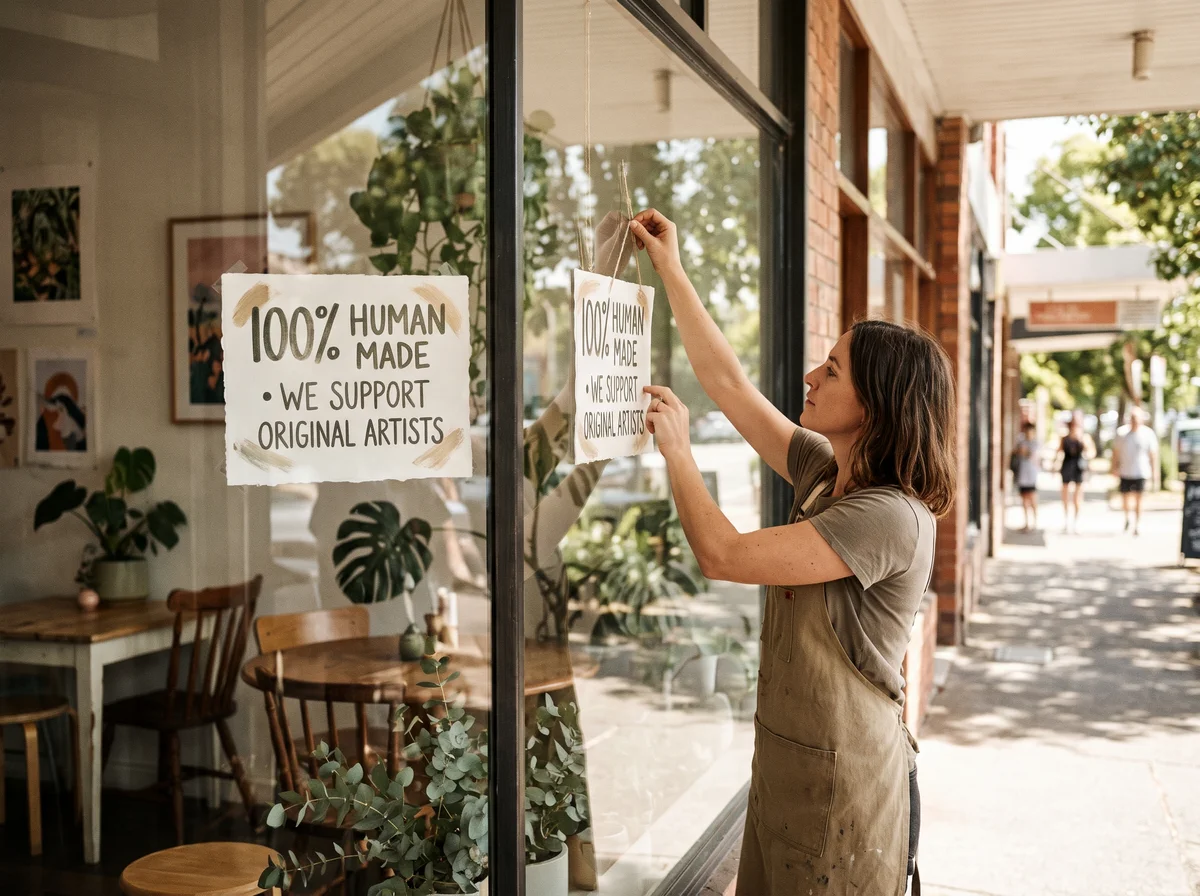
When a business chooses a human artist over an AI tool, it supports original artwork and reflects its values. Chloe Young, a 28-year-old creative from Toowoomba who runs an online sewing business, has put this approach into practice.
She offered to design handmade posters for local businesses and community groups for a small fee, or free for those who couldn’t afford it. Within days, she had nearly 30 enquiries. For many of those businesses, it was a deliberate choice to support a real person over a cheap AI-generated alternative.
Industry Bodies Banning AI-Only Creative Work
Australia’s creative industry bodies are formalising their opposition to AI-generated content through outright bans and public accountability measures. On 28 August 2026, ARIA updated its Charts Code of Practice to exclude wholly AI-generated songs from the Australian music charts. Music must now be substantially human-made to qualify.
Around the same time, Sydney booking agency Good Intent Music publicly apologised after unknowingly booking an AI artist for a live event at Bootleggers Newtown.
Both incidents reflect growing opposition to AI-generated content within Australia’s creative industry. Artists and industry organisations are calling on businesses to respect creative ownership and support human-made work (a credit alone doesn’t pay the bills).
What Is the “Stop AI Theft” Campaign Demanding?
The Stop AI Theft campaign is demanding opt-out rights, creator compensation, full transparency on training data, and the preservation of Australia’s existing copyright protections. It’s backed by the Media, Entertainment and Arts Alliance, and it represents thousands of Australian artists, journalists, and media workers.
The campaign is asking for basic fairness:
| Demand | What It Means | Current Status |
| Opt-out rights | Creators control the use of their work in AI training | Proposed, not legislated |
| Compensation | AI companies pay creators for licensed training material | Licensing options under consultation |
| Transparency | AI companies disclose the data used to train models | Under discussion |
| Copyright protection | No broad text and data mining exception in Australian law | Ruled out in October 2025 |
| Indigenous IP protection | Legal protections for First Nations cultural works | Legislation under development |
The Stop AI Theft campaign launched the #PayUp hashtag to pressure big tech companies to compensate creators for their work.
MEAA also organised an open letter addressed to the CEOs and owners of Amazon, Google, Meta, Microsoft, OpenAI and X. Australian creative and media workers used the letter to demand payment for work used to train AI systems.
Separately, APRA AMCOS led an open letter to the Australian Government, which attracted over 7,000 signatures by July 2026. The campaign called for stronger copyright protections and fair payment when AI companies use creative work without consent.
The government had already ruled out a proposed text and data mining exception in October 2025, following pressure from creative industry groups.
However, as the table shows, four of the five demands remain unresolved. Creators are still calling for stronger rights over their work, fair compensation and greater transparency from AI companies.
What Tools Are Artists Using to Fight Back Directly?
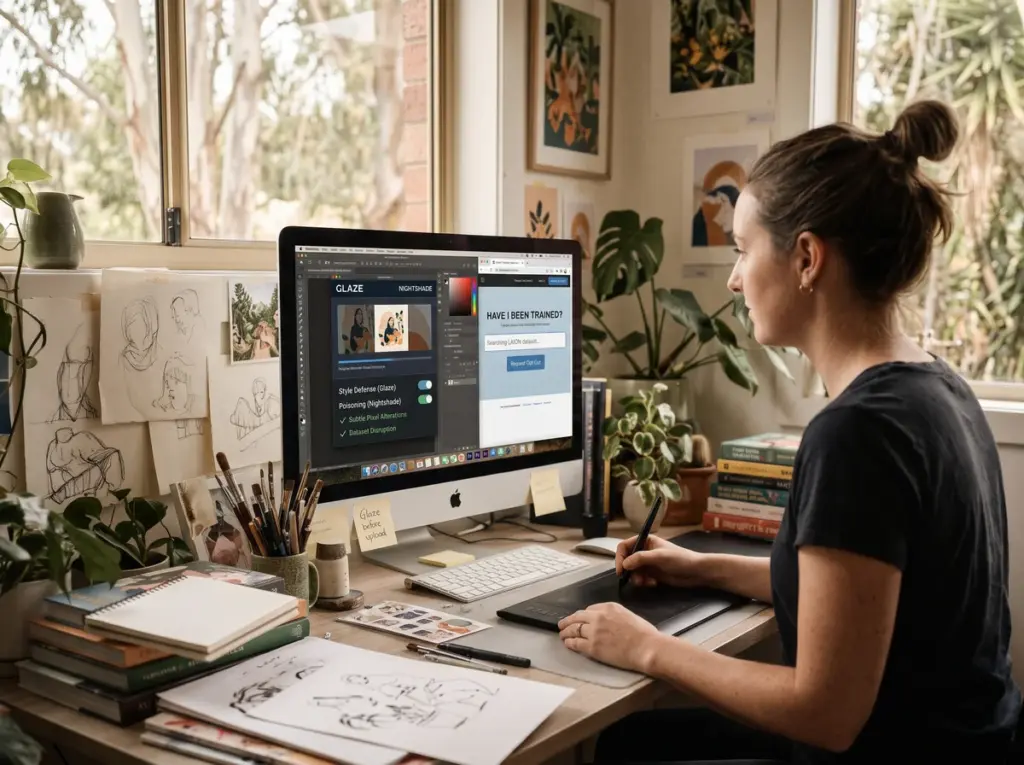
Artists are also using tools like Glaze, Nightshade, watermarking software and Have I Been Trained to protect their work from AI scraping and style theft. These tools give creators greater control over their work while broader campaigns push for stronger legal protections and industry restrictions.
Here are more details about the four tools artists are using to protect their creative work:
- Glaze: Researchers at the University of Chicago developed Glaze to add subtle pixel-level changes to artwork before artists upload it online. These changes aim to make it harder for AI models to learn and imitate an artist’s style.
- Nightshade: Nightshade takes a different approach by altering image data in ways that interfere with AI model training. When AI systems train on these altered images, they may learn incorrect associations and produce inaccurate results.
- Watermarking and Metadata: Artists can add visible watermarks or ownership details to image files before uploading them online. Although these measures don’t prevent scraping, they may help identify the creator. However, platforms can remove metadata, and watermarks don’t guarantee proof of ownership.
- Have I Been Trained: Spawning developed this tool to help artists check if their work appeared in the LAION dataset. It also offered a way to request exclusion from future AI training datasets.
These tools have limitations, and AI companies aren’t legally required to honour every removal request. Still, they offer artists practical ways to protect their work, especially when legal action is too expensive.
What Has the Australian Government Done So Far?
The Australian Government ruled out a proposed copyright exception in October 2025 that would have allowed AI training without creators’ permission. It also established a dedicated Office of AI in July 2026 to coordinate national AI policies.
However, creative professionals are still calling for clearer rules on consent, fair compensation and transparency.
Those two government decisions deserve a closer look.
Ruling Out the Text and Data Mining Exception
In October 2025, the Australian Government ruled out a proposed text and data mining exception to copyright law. The exception would have allowed AI companies to use copyrighted books, music, journalism and artwork for AI training without creators’ permission or payment.
The decision preserved existing copyright protections for Australian creators. Existing copyright protections still apply to AI training, so technology companies can’t rely on a broad text and data mining exception to use copyrighted work without permission.
Establishing the Office of AI in July 2026
When Prime Minister Anthony Albanese described the unauthorised use of Australian creative work for AI training as theft in July 2026, it drew attention to creators’ concerns. At the University of Sydney, he also announced a dedicated Office of AI within the Department of the Prime Minister and Cabinet.
The office is tasked with building Australian standards for AI systems, overseeing data centre policy, and driving copyright protections for local creators. It’s one of the government’s clearest commitments to AI oversight so far (and there’s a lot riding on the next steps).
The new office also gives AI policy a dedicated place within the federal government’s decision-making process.
What Creators Say Still Needs to Happen
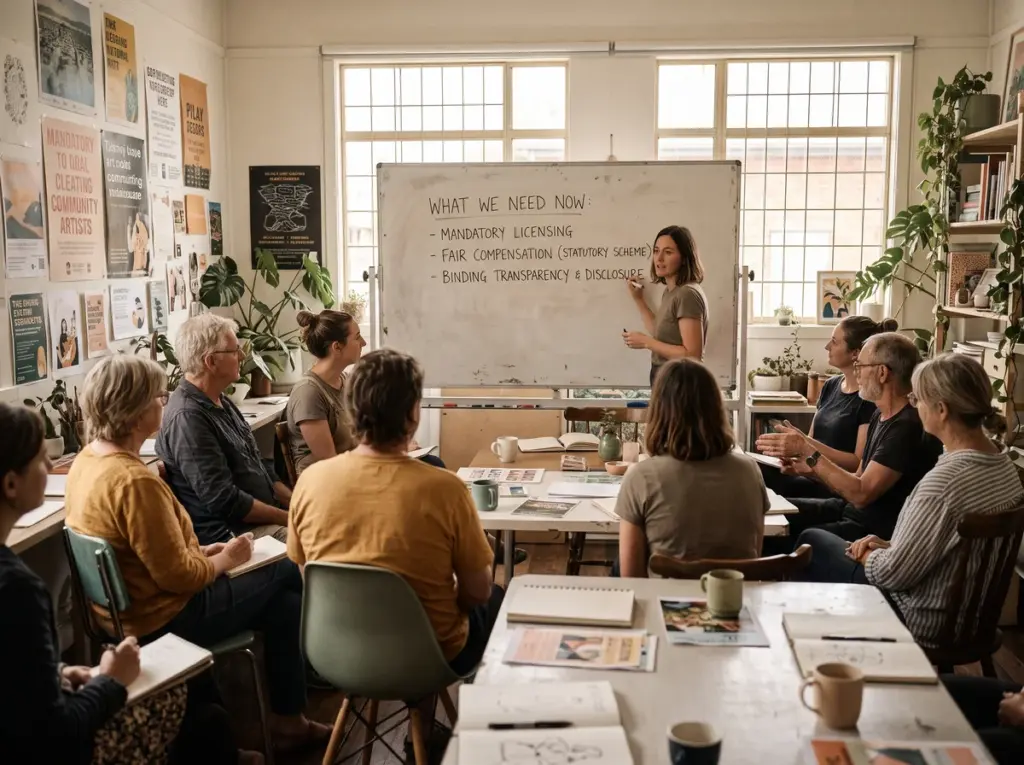
The decision to reject the copyright exception was a win, but creators still want stronger enforcement, fair compensation and mandatory disclosure rules. Australian law also lacks a general compensation scheme for creators whose work AI companies have already used for training.
There’s also no binding requirement for those companies to disclose what data their models were built on. So the creative community argues that these gaps must be addressed before legal protections offer meaningful support. Without stricter rules, artists, journalists and cultural workers who’ve already lost income to AI may continue to struggle.
In practical terms, creators are calling for mandatory licensing before AI companies can use copyrighted material, a statutory compensation scheme funded by AI companies for works already used without consent, and binding transparency requirements that force disclosure of training datasets. None of these mechanisms exist in Australian law yet.
Policy Watch: AI models trained overseas raise another concern. Australian copyright law generally can’t address overseas training, even when Australian creators’ work is involved.
Small Steps, But the Push Continues
Australia’s creative community is taking a stronger stance against the misuse of creative work in AI training. Businesses are introducing AI policies, artists are using tools to disrupt AI training, and the government has rejected a proposed copyright exception.
Although these efforts haven’t resolved every concern, they reflect growing pressure for stronger protections.
If you run a small business, the simplest thing you can do right now is choose human. Commission a local artist, post your AI policy publicly, and let your community know where you stand.
If you’re interested in the latest news on AI and other developments across Australia, follow our stories. We’ll keep you updated on what’s happening and how it affects Australian businesses.
Frequently Asked Questions About AI Art in Australia
The debate around AI art also raises practical questions for businesses and customers. Here are some common questions about finding artists, protecting creative work and managing projects.
How Can You Tell If Real Art Was Created by a Human?
Ask for sketches, a reference image or photos from the creation process. Advanced tools can imitate human techniques, so these records aren’t definitive proof. A conversation with the artist offers additional context.
Where Can Small Businesses Fighting AI Art Find Creative Partners?
Local Facebook groups, art schools and creative directories are good starting points. For example, a community exhibition may introduce you to artists open to collaboration. These resources also help businesses find talent outside major cities.
What Are the Benefits of Hiring Artists for Long-Term Projects?
An ongoing collaboration gives artists time to understand your brand and develop fresh ideas. It also supports consistent creative work across campaigns, rather than starting every job with someone new.
What Security Risks Come With Uploading Images to an AI Chatbot?
Some services retain uploaded files or use eligible content for model training, depending on their policies and settings. Before granting access, check the provider’s privacy terms. Avoid uploading confidential client images without permission.
How Should Businesses Budget for Original Creative Work?
Start with the project’s scope, usage rights and revision needs. Ask artists for itemised quotes before committing. A realistic budget also leaves room for feedback and unexpected changes.
What Should a Business Do If an Artist Misses a Creative Deadline?
Review the agreed delivery terms and discuss a revised schedule with the artist. If the delay affects a campaign, consider alternative deliverables. Any changes to deadlines or costs should be agreed upon.
How Can Businesses Present Human-Made Art Online?
Share the artist’s name, past work and the idea behind each piece. For instance, a short studio video could show their creative ability. Ask permission before sharing any behind-the-scenes content.
What Should Businesses Ask Before Buying Art From Online Sites?
Check who owns the art work and what commercial rights come with it. A responsible buyer should also ask about reproduction limits.