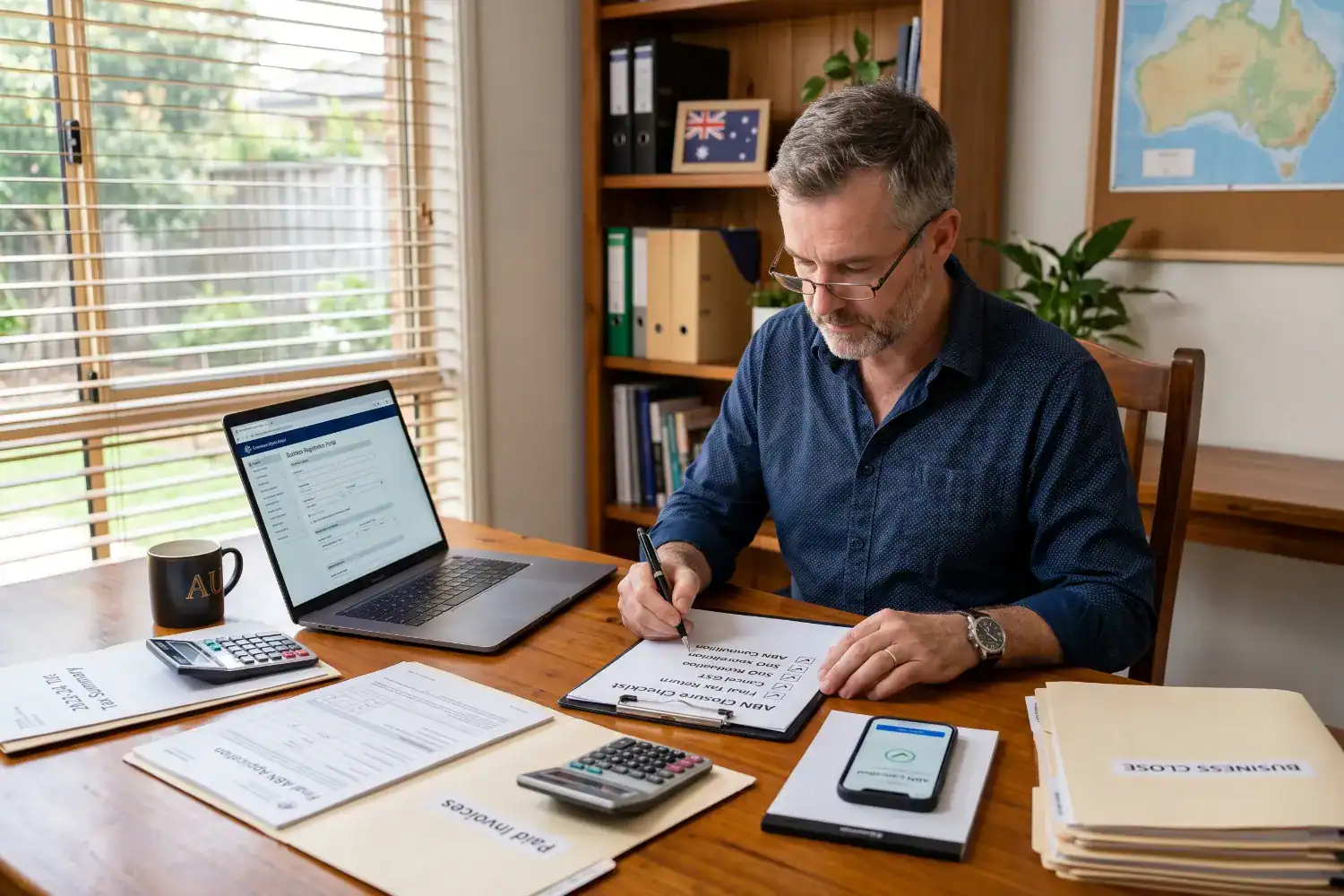
Closing a business in Australia isn’t something most directors plan for when they start out, but life happens. Markets shift, priorities change, or maybe the venture just didn’t work out as expected. The reasons for closing a business are as varied as the businesses themselves.
If you’re running a Pty Ltd company that’s reached the end of its road, you can’t just walk away. Company deregistration is a legal process with strict rules, and skipping steps can cost you thousands in penalties or leave you personally liable for debts.
Fortunately, if you follow the right process, closing your business doesn’t have to be complicated or expensive. Let’s break down exactly how to close a Pty Ltd company in Australia, step by step.
What Is Company Deregistration in Australia?

Company deregistration is the legal process that removes your Pty Ltd from the Australian Securities and Investments Commission (ASIC) register. Every Australian company must follow this process through ASIC.
Once the organisation completes the deregistration, your company no longer exists as a legal entity. And the moment you deregister your company, it loses all rights to:
- Trade
- Own property
- Enter into contracts
- Employ staff
- Hold bank accounts
So basically, it can’t operate in any capacity, and it’s completely dissolved.
At the end of the day, deregistration is permanent. Your company’s name becomes available for others to register, and all its legal responsibilities cease. But before you get there, you need to meet specific requirements and follow ASIC’s process exactly.
What Are the Different Ways to Close a Pty Ltd Company?
You’ve got 3 main options: voluntary deregistration, members’ voluntary liquidation, and creditors’ voluntary liquidation. The right option depends on whether your company can pay its debts and how much it owns.
Here’s how they work:
Voluntary Deregistration
Voluntary deregistration is the easiest method of closure for companies with minimal assets and no liabilities.
You’ll need all shareholders to agree, and your business must meet strict ASIC requirements before applying. The process costs $50 in application fees and takes around 3 months from start to finish.
Members’ Voluntary Liquidation (MVL)
Members’ voluntary liquidation is designed for solvent companies with substantial assets that need a formal distribution to shareholders.
You’ll use this method when your business has assets over $1,000 that need to be distributed properly. Directors must sign a solvency declaration confirming the company can pay all debts within 12 months. After that, a registered liquidator takes over to manage asset sales, settle any remaining debts, and distribute funds to shareholders before ASIC deregisters the company.
Creditors’ Voluntary Liquidation (CVL)
When your company can’t pay its debts, creditors’ voluntary liquidation protects you from worse outcomes like court action.
Directors appoint a liquidator to manage the company’s debts. A liquidator will sell the company assets and distribute the proceeds to creditors in the order the law requires.
Helpful Tip: Act early and follow the process correctly to avoid personal liability claims that come from trading while insolvent.
What Are the Requirements for Voluntary Deregistration?
Meeting ASIC’s six requirements for voluntary deregistration saves you thousands compared to liquidation.
Your company must tick every single box before ASIC will accept your application. Cutting corners on any requirement means automatic rejection, and you won’t get your application fee back.
So strictly follow these requirements from the table below:
| # | Requirement | What It Means |
| 1 | All shareholders agree | Every member must consent to deregistration in writing |
| 2 | Not conducting business | The company has stopped all trading activities |
| 3 | Assets under $1,000 | The total company’s assets are worth less than $1,000 |
| 4 | No outstanding liabilities | All debts, wages, and obligations fully paid |
| 5 | Not in legal proceedings | No current or pending court cases |
| 6 | ASIC fees paid | All annual review fees and penalties payable have been settled |
The company must have ceased trading completely before you apply. This includes paying all fees and penalties payable to ASIC. And you can’t be involved in any legal proceedings when you lodge Form 6010.
How Do You Apply for Voluntary Deregistration?

The voluntary deregistration process involves four main steps, from gathering documents to waiting for ASIC’s final approval. Each step builds on the previous one, so missing even one detail can quickly derail your application.
Gather Required Documents
To lodge Form 6010, collect the documents that prove your company meets ASIC’s requirements.
Start by preparing a members’ resolution signed by all shareholders showing that the company agrees to close the business completely. You should also make sure your final tax returns, BAS statements, and employee entitlements documentation are completed and filed with the ATO. And you’ll need proof that you have paid all ASIC annual fees and any outstanding penalties in full.
Form 6010 Lodgement
Lodging Form 6010 online through ASIC’s portal is faster and reduces the risk of application errors or delays. But before you hit submit, directors must certify that you have met all deregistration requirements before lodging the application.
Quick Tip: Lodge at least two weeks before your annual review fee due date to avoid paying unnecessary costs.
Application Fee Payment
You must settle any outstanding ASIC fees, like annual review charges and late penalties, before the deregistration process can move forward. Otherwise, your application gets rejected automatically.
And ASIC won’t refund your $50 application fee even if they reject youy request. Also, if you don’t pay the fee within 28 days of submission, your application lapses completely (and no, the organisation doesn’t make exceptions).
ASIC Approval Timeline
ASIC takes 2 to 3 weeks to assess your application before publishing the deregistration notice publicly. The regulator examines your submission and notifies you of approval or rejection within this timeframe.
Once approved, they publish a notice on the ASIC Gazette website immediately. Two months after the notice goes live, the regulator finalises the process, and your company’s status changes to deregistered.
What Tax Obligations Must You Complete Before Closing?
The ATO won’t let you walk away until every tax obligation is settled, lodged, and cancelled properly. These four steps cover everything the tax office requires before ASIC will approve your deregistration:
- Lodge Final Tax Returns: Your company must submit its final tax return and all outstanding business activity statement lodgements with the ATO. This includes any quarterly or monthly BAS you haven’t filed yet. The ATO needs to see a complete tax history before they’ll clear you for closure.
- Cancel GST Registration: After you’ve lodged your final BAS, cancel your GST registration to stop ongoing reporting requirements. You can’t keep this active once the business closes, and the ATO will expect regular filings if you don’t officially cancel it.
- Settle Superannuation Obligations: Pay all employee superannuation guarantee contributions owed and close payroll accounts with the ATO. Any unpaid super can trigger Director Penalty Notices that make you personally liable, even after the company no longer exists.
- Cancel Your ABN and Business Registrations: In our conversations with accountants across Brisbane, the ABN cancellation step is the one most directors forget to complete. But you must cancel your ABN with the Australian Business Register once all tax obligations are finalised. This includes cancelling any business names registered under the company.
Once the ATO side is sorted, you’ll need to deal with what happens to everything the company owns.
What Happens to Company Assets and Liabilities?

Under section 601AA of the Corporations Act, your company’s assets must be worth less than $1,000 to qualify for voluntary deregistration. This means you should sell or distribute most company property before applying. If you don’t deal with assets properly, they vest in ASIC or the Commonwealth in its own right, and you can’t recover them (which explains why so many directors lose money unnecessarily).
Now for the liabilities side. You need to clear all outstanding debts and payment obligations before lodging your application. A company with outstanding liabilities, including tax liabilities and fees or penalties payable under the Corporations Act, cannot be deregistered.
And most importantly, you must settle employee entitlements like wages, annual leave, long service leave, and redundancy pay before you can apply. ASIC won’t accept your deregistration if employees are owed anything, so plan for these costs before you lodge Form 6010.
While you’re sorting through assets and debts, there’s another risk you need to understand as a director.
What Are Your Personal Liability Risks as a Director?
You face personal liability for unpaid PAYG, GST, and superannuation through Director Penalty Notices from the ATO. The tax office can pursue you personally for these obligations even after your company closes. And these penalties don’t disappear just because the business no longer exists.
On top of that, trading while insolvent makes directors personally liable for debts incurred after insolvency became evident. If you continue operating when you know the company can’t pay its bills, creditors can come after you directly for those losses.
And here’s one many directors forget: personal guarantees to banks or suppliers remain enforceable against you even after company closure. You signed those guarantees in your own capacity, so they survive deregistration and can generate legal claims for years (even if you thought closing the company would end them).
How Long Does the Deregistration Process Take?
If everything runs smoothly, the full deregistration process takes approximately 3 months from lodging Form 6010 to final closure. The timeline breaks down like this:
| Stage | Timeframe |
| Document preparation | 1-2 weeks |
| ASIC processes application | 2-3 weeks |
| Notice published in ASIC Gazette | Immediately after approval |
| Waiting period after publication | 2 months |
| Final deregistration | The day after waiting period ends |
| Total timeline | Approximately 3 months |
ASIC publishes the notice on the date they approve your application. 2 months later, the organisation finalises the deregistration, and your company’s status officially changes to deregistered.
Important Note: These timeframes assume you’ve ticked every box correctly.
What Are the Costs of Closing a Pty Ltd Company?

The final cost depends on your closure method, ranging from $50 for simple deregistration to $15,000+ for liquidation. See how they compare here:
ASIC Deregistration Fees
As we already mentioned, if you’re considering the simplest route to close your company through voluntary deregistration, it costs $50 as the application fee. That’s what makes it the most affordable closure option available.
But yes, you need to pay any outstanding annual review fees before ASIC accepts your deregistration request for processing. And if you’ve missed payments, late fees start at $98 for up to one month late and jump to $411 after that.
Liquidator Appointment Costs
Liquidation (formal winding up) fees start at $4,000 for simple cases but can reach $30,000 or more depending on your company’s situation.
For instance, members’ voluntary liquidation typically costs between $4,000 and $8,000, while creditors’ voluntary liquidation averages $15,000 minimum. Cases involving multiple creditors, disputes, or investigations can exceed $30,000 in total fees.
Professional Service Expenses
Hiring accountants and lawyers for closure work prevents costly mistakes that could delay deregistration or trigger personal liability.
Most accountants charge $500 to $2,000 for final tax returns, BAS statements, and ATO compliance work. And legal fees for reviewing contracts, preparing resolutions, and advice typically range from $1,000 to $3,000 across the industry.
After observing many business closures around Melbourne, we’ve found that most directors underestimate these expenses when budgeting for closing their business and end up scrambling for extra money at the last minute. So remember you’ll need to pay for document preparation, members’ resolutions, and ASIC form completion if using professional services.
What Happens If You Don’t Formally Close Your Company?
Without formal closure, ASIC initiates deregistration after 12 months of unpaid annual review fees, but you lose control over when it happens (even years after you’ve moved on). The organisation can still charge penalties for late filings and unpaid fees during that entire period.
The truth is, walking away creates bigger problems down the track. Creditors can reinstate a deregistered company and pursue debts from directors personally.
Simply put, your liability for unpaid PAYG, GST, and superannuation doesn’t disappear just because you stopped business operations. As a director, you remain legally responsible for lodging annual returns and meeting compliance obligations until ASIC finalises the process.
So if you’re thinking of abandoning your company, reconsider and follow the proper process instead.
Can You Reinstate a Deregistered Company?
Yes, you can reinstate a deregistered company, but only if you meet ASIC’s criteria or get a court order.
The organisation can bring back a deregistered company if specific criteria are met and fees are paid. For example, you must:
- Be a former director, secretary, or shareholder when the company was deregistered
- Not be disqualified from managing corporations
- Confirm the company will be solvent when reinstated
- Pay all outstanding ASIC fees and penalties
- Provide a valid reason why the deregistration shouldn’t have happened
Worth Noting: You’ll need a valid reason for reinstatement, like unfinished legal matters or undistributed assets that need proper handling.
If you don’t meet ASIC’s administrative criteria, courts can order reinstatement if creditors, shareholders, or ASIC request it. Reinstatement restores the company’s registered status as if it were never deregistered, including all director responsibilities and liabilities.
When Should You Seek Professional Help?
Most company closures involve tax, meeting legal obligations, and compliance issues complicated enough to warrant professional guidance from the start.
Companies with assets over $1,000, ongoing contracts, or employee entitlements especially need an accountant and a lawyer to support them and avoid costly mistakes. One missed step in distributing assets or settling employee claims can trigger personal liability that follows you for years.
That’s why any uncertainty about solvency status or director duties risks requires immediate professional advice. Honestly, the legal requirements around closing a business properly can trigger serious consequences if you get them wrong.
If you’re still on the fence, tax work alone justifies the cost. Final returns, BAS lodgements, and ATO obligations involve multiple steps that accountants handle daily. You don’t want to risk Director Penalty Notices because you missed a superannuation payment deadline.
For a complete overview of how to close a business in Australia, including when to contact professionals at each stage, check our detailed business closure guide.
Take the Right Steps to Close Your Company
Closing your business properly protects you from personal liability and keeps you on the right side of Australian law.
You might choose voluntary deregistration, liquidation, or another pathway, but following ASIC’s requirements exactly is non-negotiable. Missing steps or rushing the process creates problems that can follow you for years. The most important thing is understanding which closure method fits your situation and completing every requirement before you deregister a company.
Want more insights on running and growing your Australian business? Visit Australian Business Magazine. We share practical guides, founder stories, and strategies to help you build a stronger company.