Nearly 80% of Australian SMEs have experienced cash flow problems in the past year, according to research from CommBank and UNSW. That’s roughly two million businesses struggling to keep money moving through their accounts.
In fact, small to medium enterprises in Australia make up over 97% of all businesses. So when these enterprises struggle, the impact spreads across the wider Australian economy.
However, SMEs don’t have the same financial buffer as larger companies. This leaves smaller companies more exposed to rising costs, late payments, and staff shortages, which can quickly put pressure on already tight margins.
If you’re a small or medium-sized business in Australia, read on. This article will cover the biggest challenges for SMEs in Australia, the statistics behind them, and the support options you should know about.
What Are the Biggest Australian SME Financial Struggles?

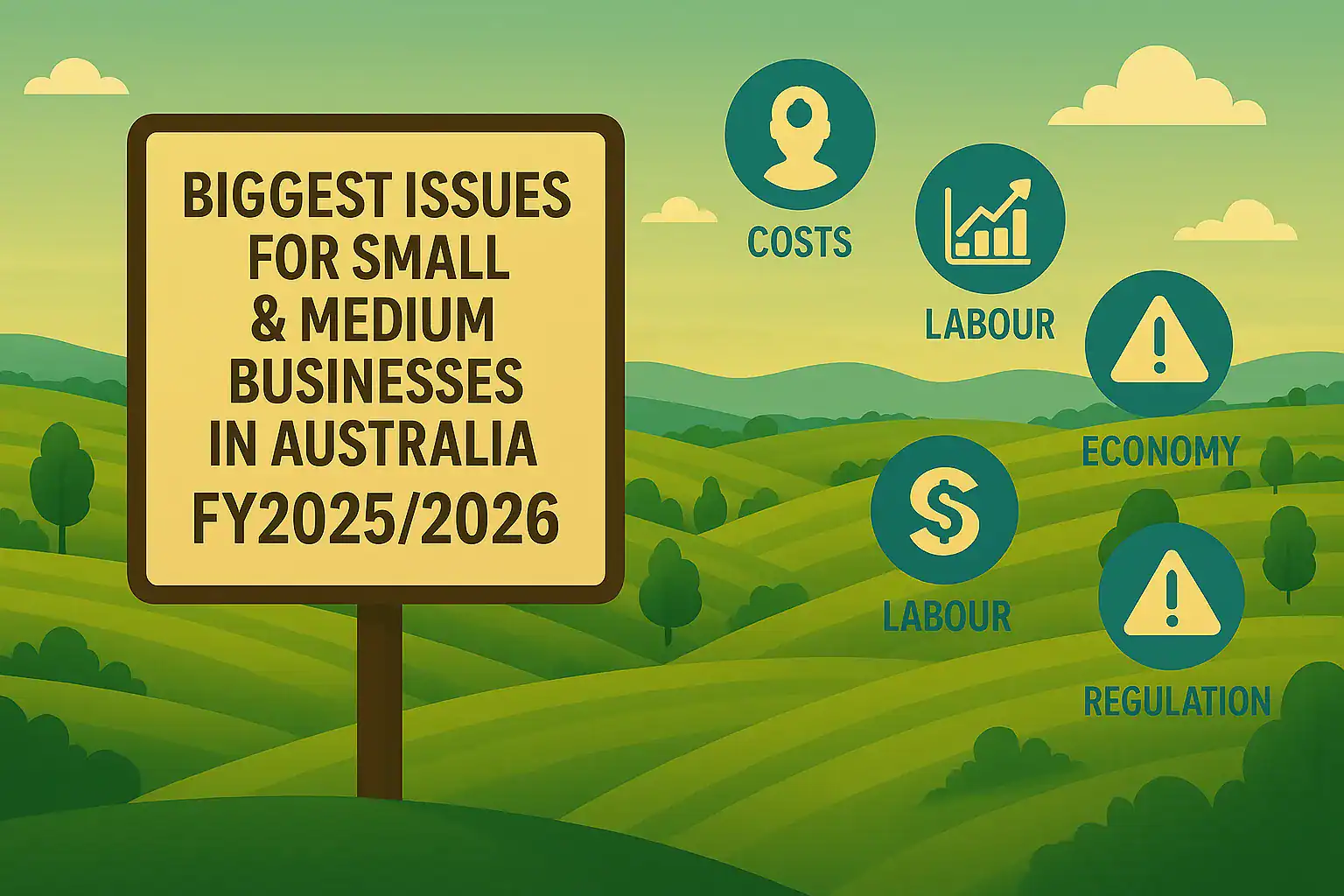
As we mentioned before, Australian SMEs deal with a range of financial struggles, like rising costs, unpaid invoices, and staffing gaps that reduce profits over time. Right now, these are what’s hitting business owners the hardest:
- Rising Operating Costs Across Industries: The cost of running a business keeps climbing as energy bills, rent, insurance, and supplier prices have all increased over the past 2 to 3 years. In fact, 82% of SMEs say wage inflation is their biggest cost pressure, while 49% point to electricity. Which means, many owners are forced to raise prices or cut back elsewhere just to protect their margins.
- Cash Flow Constraints in Small Business: As invoices stretch out to 45 to 65 days, businesses are struggling to cover wages, rent, and supplier bills on time. Without strong cash flow management, planning ahead is becoming almost impossible, and even profitable businesses are facing serious financial trouble.
- Hiring Challenges and Workforce Shortages: On top of financial pressures, finding the right employees is still a major struggle. According to Jobs and Skills Australia, 29% of occupations are in shortage nationwide. For SMEs, that means fewer qualified candidates and longer hiring times.
- Regulatory and Tax Compliance Pressures: Tax obligations, employment laws, and reporting requirements all can eat up time and money. Unfortunately, most SMEs don’t even have dedicated compliance staff, so owners end up handling it themselves on top of everything else.
- Technology and Innovation Gaps: Tight budgets are also stopping many SMEs from investing in digital tools that could save time. This is slowing down productivity and making it harder to keep up with larger competitors who are already focused on automation and innovation.
- Economic Uncertainty in Australia’s Economy: Finally, changes in inflation and interest rates are making long-term planning difficult. After all, when the economy becomes unstable, consumer spending usually slows. And that drop in spending often hits small and medium businesses first, before larger companies feel the impact.
These issues tend to overlap and feed into each other, which is why tackling them usually takes a clear strategy. Our next sections will break down each challenge in more detail and look at what support is available.
How Many SMEs Operate in Australia and What Do the Latest Statistics Show?
As of June 2025, around 2.73 million businesses were actively trading across the country, and the vast majority of them are small or medium-sized. These statistics show just how much the economy depends on smaller operators. So let’s break down the numbers.
Total Number of Businesses and SME Estimates
If we’re being specific, the Australian Bureau of Statistics reports that there were 2,729,648 actively trading businesses in Australia at the end of the 2024–25 financial year. Out of that total, 97.2% are small businesses with fewer than 20 employees (think your local tradie or corner shop).
Medium businesses sit in the next category, which covers those with 20 to 199 employees, and they make up another 2.4%. That leaves less than 1% of all businesses in the large category.
Note: These figures are based on employee count rather than annual turnover. This means a business can earn high revenue but still be counted as small if it has fewer employees.
Contribution of SMEs to Employment and Economic Activity
As you can tell, small and medium enterprises do a lot of the heavy lifting when it comes to jobs and economic output in Australia. In fact, small businesses alone employ over 5.1 million Australians, which adds up to about 42% of the private sector workforce.
On top of that, they contribute roughly one-third of Australia’s GDP. Their role is even more significant in certain industries like construction, retail, and professional services. In construction, for example, small businesses account for 62% of all jobs in the sector.
How Do Official Definitions of SMEs Differ in Australia?
The definition of an SME changes depending on which framework you look at. For instance, the Australian Bureau of Statistics defines small businesses as those with fewer than 20 employees, while medium-sized enterprises have between 20 and 199.
The Australian Taxation Office, on the other hand, uses annual turnover instead. So, under their system, a small business is one that earns less than $10 million per year.
Because of this change in criteria, business statistics and reporting can vary depending on the definition used. In other words, a business may be classified as “small” under one system but not under another.
Why Do Small and Medium Enterprises in Australia Face Cash Flow Issues?

Cash flow is a major challenge for Australian SMEs because money often goes out faster than it comes in. If you remember us mentioning earlier, nearly 80% of small businesses felt the impact in the past year, which shows how common this issue is. Here are the main reasons behind it:
- Late Payments From Customers: When customers delay paying invoices, it creates a ripple effect. The average small business waits 45 to 65 days to get paid, which is well beyond standard 30-day terms. That delay can hold back money needed for wages, rent, and supplier bills.
- Limited Access to Finance and Loan Options: Many SMEs struggle to secure funding from banks due to strict lending criteria. In fact, one in five small businesses that need funding cannot access it, often due to high costs or strict approval requirements.
- Poor Cash Flow Forecasting and Management: Without proper accounting tools, it can be hard to track incoming payments and outgoing expenses. Because of this, planning ahead gets more difficult. Even shortfalls in cash for things like wages or supplier bills can quickly grow and turn into bigger problems.
- Low Working Capital Reserves: Many businesses operate with fewer financial buffers than they need. So when unexpected costs hit, there’s little room to absorb the shock.
- Irregular Revenue Cycles Across Industries: Some industries, like retail and hospitality, experience seasonal swings in demand. That uneven income can make it harder to cover fixed costs during slower periods, like off-peak seasons or low-sales weeks.
Managing cash flow takes ongoing attention, but understanding these causes is your first step to improving how you manage your money and avoiding shortfalls. The next section will look at how rising operating costs add even more pressure to already tight margins.
How Do Rising Operating Costs Affect SMEs in Australia?
Rising operating costs put pressure on Australian SMEs, and businesses feel this across almost every industry. This pressure mainly comes from higher electricity bills, supplier prices, and rent, all of which have increased over recent years. And because of these rising costs, profit margins are shrinking and forcing owners to make tough decisions about pricing and spending.
Here’s a closer look at what is causing these cost increases.
Energy and Utility Cost Increases
Electricity prices continue to rise for small business owners across Australia, and there’s no sign of that slowing down. Take a look at New South Wales, South Australia, and South East Queensland, for example. Businesses in these regions have faced electricity price increases of up to around 8% to 9% since mid-2025 (that’s on top of previous years’ hikes). And higher energy costs are still putting pressure on operating expenses in 2026.
However, industries like hospitality feel this pressure more strongly since restaurants run fridges, ovens, and air conditioning all day. And as energy bills rise, these SMEs face two choices: they either absorb the cost and accept lower margins, or raise prices and risk losing customers.
Supplier and Resource Price Growth
Inflation and supply chain disruptions since around 2022 have pushed resources like timber, steel, and imported goods to higher price points than before. In construction and retail, these increases make it particularly harder to deliver projects on budget or keep shelves stocked at competitive prices. That’s why many SMEs now struggle to manage procurement costs without reducing profitability too much.
Rental and Property Cost Increases
Commercial rental costs add another layer of pressure for business owners trying to stay afloat. This is because most lease agreements include annual increases linked to CPI (Consumer Price Index) or fixed percentages, which push costs higher during periods of high inflation.
As a result, businesses in metro areas like Sydney and Melbourne usually pay more than those in regional areas. However, that gap is narrowing in some sectors like retail and hospitality.
Either way, rent remains one of the highest fixed costs for service-based SMEs, and unlike other expenses, it’s not easy to reduce or negotiate.
How Do Economic Conditions and Market Trends Impact Australian SMEs?

Economic conditions in Australia’s economy have a direct impact on how Australian SMEs perform and plan for the future. Yes, factors like inflation, interest rates, and consumer confidence are outside the control of most business owners. But you can’t deny that they still influence customer spending and borrowing costs, which affect day-to-day business decisions.
However, if you understand how they work, you can make better decisions when conditions change. This is how the major economic factors tend to play out.
Table: Key Economic Factors Affecting SMEs in Australia
| Economic Factor | Impact on SMEs | Business Outcome |
| Inflation | Reduced spending power | Lower demand and sales |
| Interest Rates | Higher borrowing cost | Slower business growth |
| Consumer Confidence | Fewer customers in the market | Reduced annual turnover |
| Market Volatility | Uncertain planning environment | Delayed investment decisions |
As you can see, when inflation rises, interest rates often increase as well, and potential customers usually cut back on spending. That means fewer sales for SMEs and less cash flowing through the business. On top of that, higher borrowing costs make it harder to secure a loan for expansion or new equipment.
According to the Reserve Bank of Australia, inflation has stayed above the 2–3% target range since 2022 (which might explain why your regulars are visiting less). This has slowed economic growth and changed how consumers behave.
And so, SMEs face more difficulty reaching their target market.
Why Is Hiring Difficult for SMEs in Australia?
Hiring is difficult for SMEs in Australia because skill shortages, higher employee expectations, and competition from larger employers are making it harder to find the right people. But understanding these barriers can help you adjust your approach and make smarter decisions.
In this section, we’ll dig deep into what’s making recruitment so difficult.
Shortage of Skilled Employees in Australia
Skill shortages continue to hold back employment growth across many industries. As we mentioned earlier, in 2025, 29% of occupations were in shortage nationally, which is only slightly down from 33% the year before.
And as you already know, these issues are most visible in sectors like health, construction, and hospitality. That’s actually because SMEs in these industries have fewer qualified candidates to choose from. So the hiring process often takes several weeks or even months longer than expected.
Competition From Large Australian Businesses
Another issue is large Australian businesses. Since they can offer higher pay, more benefits, and clearer career paths, most SMEs cannot match these packages.
So when a candidate compares a corporate job with a smaller company role, which do you think wins? It usually leans toward larger companies. Even if an SME offers a better culture or more hands-on experience, it can still be hard to stand out.
Changing Workforce Expectations
Around 2020, the pandemic made remote work more common and pushed employees to rethink work-life balance. That’s why more employees now want flexibility, remote work options, and a better work-life balance than they did before (no surprise there, really).
However, for SMEs without the management systems to support hybrid setups, it can be difficult to meet these demands. Plus, if a competitor down the road offers what your candidate is looking for, retention becomes just as difficult as recruitment. So even after you hire someone, keeping them long-term is another challenge entirely.
Recruitment and Training Challenges
Beyond finding the right person, there’s also the cost of bringing them on board. This starts with writing job ads, then moves to reviewing applications, running interviews, and training new employees.
For a small business owner already stretched thin, each of these hiring decisions carries significant risk. And if that new employee leaves within a year or two, the business doesn’t always recover the investment. That’s why getting the hire right the first time is so important.
Why Do Australian SMEs Struggle With Digital Adoption and Innovation?

Many Australian SMEs find it hard to keep up with digital change because of tight budgets and limited in-house expertise to manage new tools and systems. And for owners already juggling a dozen things (which, let’s be honest, is most of them), new technology often falls to the bottom of the list.
Let’s look at what tends to hold them back in detail:
- Limited Access to Technology and Tools: A lot of SMEs still run on outdated systems like spreadsheets or basic accounting software that aren’t built for today’s digital demands. Without access to modern tools like cloud platforms and automation, it’s much harder to improve efficiency or keep up with larger businesses that have already made the switch.
- High Implementation and Maintenance Cost: Now, on the contrary, while modern tools are useful, these new technologies aren’t always cheap. For many SMEs, the upfront cost alone is hard to justify. And on top of that, there’s ongoing maintenance and updates to pay for. That kind of spending is tough to fit into a tight budget model.
- Cybersecurity and Data Protection Risks: As more business activity moves online, the risk of cyber threats is growing. However, many SMEs don’t have the resources to secure their systems properly, which leaves them open to data breaches, ransomware, and other attacks. According to KPMG, 42% of business leaders now rank cyber risk among their top three concerns.
- Lack of Skilled Employees in Digital Areas: Even if SMEs want to adopt new technology, finding employees with the right digital skills can be difficult and time-consuming. As we covered earlier, skill shortages affect many industries across Australia, and tech-related roles are no exception.
- Integration Issues Across Business Systems: Adding new software to existing systems can often take several weeks to a few months. That’s because different platforms don’t always work well together, which can cause delays and errors. And so, both management and staff often face extra work and disruption.
- Slow Adoption Across Traditional Industries: Now, some industries like retail, construction, and professional services have been slower to adopt digital tools than others. Instead, they rely on familiar processes like paper-based records, manual paperwork, and in-person communication. While none of these processes is necessarily outdated or ineffective for daily operations, they do make digital change feel more risky or unnecessary.
These barriers can limit innovation and slow down long-term growth if left unchecked. But for SMEs that push through them, digital solutions can improve productivity and overall business performance.
How Do SME Challenges Differ Across Key Industries in Australia?

SME challenges across key industries in Australia differ based on cost pressures, customer needs, and workforce demands.
While businesses often face similar issues like cash flow, staffing, and technology adoption, these challenges show up in different ways across sectors. For example, a construction company deals with different daily pressures than a café or a consulting firm.
In this section, we’ll look at the biggest challenges that play out across some of Australia’s key industries.
Construction Industry Cost and Resource Challenges
Construction SMEs are under serious pressure from rising material costs and ongoing labour shortages. According to the Australian Bureau of Statistics, project costs have jumped by around 40% since the pandemic. This has led to higher costs on every project they take on.
On top of that, many firms still struggle to find skilled tradespeople, which slows down work on-site. And if suppliers delay deliveries or workers are not available, projects fall behind schedule and become harder to manage. Unfortunate for SMEs working on tight margins, even small delays can quickly reduce profits.
Retail and Hospitality Customer Demand Fluctuations
Retail and hospitality businesses rely heavily on customers who are willing to spend. However, ongoing cost-of-living pressures have led many households to cut back on non-essential purchases. This has reduced overall customer spending in many areas, like dining out, entertainment, and retail shopping.
Seasonal patterns create further instability, with demand rising during holiday periods and school breaks, and falling during weekdays and off-peak travel periods. All of these changes mean SMEs now must closely track customer behaviour to stay responsive to changing demand.
Professional Services Talent and Growth Pressure
In professional services, competition for skilled workers remains fierce. Particularly, fields like accounting and consulting are facing serious talent shortages.
This is reflected in falling enrolments in accounting programs since 2020, which has reduced the number of new graduates entering the job market. In response, many firms have raised salaries, with 74% of accounting firms surveyed by Advancetrack increasing pay to attract and retain staff.
However, for smaller firms, that makes hiring harder and puts more pressure on the people already working there. Unfortunately, client expectations are also rising at the same time, and scaling the business to meet that demand often requires dedicated resources that many SMEs just don’t have.
Real Estate Services and Shifting Buyer Demand
Now, compared to other service-based industries, real estate services are more strongly affected by changes in interest rates. Once borrowing costs rise, real estate agents often see buyers step back from the market (which slows property transactions).
Because of this, smaller real estate agencies experience uneven income as revenue rises and falls from month to month. While lower interest rates may bring some relief, agency income still depends heavily on overall market conditions.
What Support and Solutions Help SMEs Grow in Australia?
Australian SMEs have plenty of resources out there to help businesses manage costs, improve cash flow, and plan for the future. Here’s a look at the main types of support worth knowing about, including government grants and digital tools.
- Government Support Through Business.gov.au Programs: The Australian Government provides a range of grants and advisory services through Business.gov.au. One example is the Industry Growth Program. It offers funding of up to $5 million to help small business owners turn new ideas into products and expand into new markets. If you’re ready to grow or innovate, this support is worth looking into.
- Australian Taxation Office Concessions and Tax Support: If you’re looking for a practical way to free up cash, the Australian Taxation Office offers tax concessions that can help by freeing up cash for reinvestment. We recommend the instant asset write-off, which allows eligible businesses to deduct the full cost of assets under $20,000 in the year they purchase them. It’s a practical way to upgrade equipment without the wait.
- Access to Finance, Loan, and Bank Support: When internal funds aren’t enough, many SMEs turn to banks and other lenders for support. In particular, they use options like business loans, overdrafts, and invoice financing to secure working capital during slower periods. This often helps them manage daily expenses when cash flow is tight. However, it’s important to explore these options early, before cash flow becomes a serious problem.
- Accounting and Cash Flow Management Solutions: Good financial management starts with tools that help SMEs track money, monitor cash flow, and make informed decisions. Cloud-based accounting software supports this by recording income and expenses, sending invoices quickly, and keeping financial data updated in real time. This helps business owners spot issues early and plan with greater control.
- Digital Tools and Innovation for Business Growth: Technology can also help SMEs expand more efficiently. It supports this through tools like customer management systems and automated scheduling, which reduce the need for manual work. For businesses looking to grow without adding extra staff, innovation in this area can improve efficiency and support higher output with the same team.
- Industry-Specific Support Across Services and Construction: Some industries have access to targeted programs designed just for them. For example, in construction, there are apprenticeship subsidies and insurance schemes that help businesses deliver projects safely and protect their workers’ health. So we recommend checking what’s available in your sector, as you might be missing out on this useful support.
- Professional Services and Business Advisory Support: Finally, professional advisors like accountants, lawyers, and business consultants can provide valuable support. They help SMEs stay compliant with tax and employment laws, and offer guidance on how to scale sustainably. For many business owners, this kind of expert input is what keeps daily operations and long-term planning running smoothly.
So, as you can see, the right solutions for you will depend on where your business is at and what you’re trying to achieve. However, with this support available, you have more options than ever to set themselves up for a stronger future.
What Is the Future Outlook for SMEs in Australia?

The future for SMEs in Australia looks cautiously positive, but it won’t be without its challenges. With millions of small and medium businesses making up the backbone of the economy, how they adapt over the next few years will influence broader economic growth.
This is what the outlook looks like across three key areas.
Economic Trends Shaping SME Growth
Inflation and interest rates will continue to play a big role in how Australian SMEs plan and invest. According to the OECD, GDP growth is expected to reach 2.3% in 2026 and 2027, with unemployment staying low and inflation moving closer to target.
This statistic points to a more stable economy ahead, which should improve demand and give businesses more confidence to make longer-term decisions. That said, the cost of borrowing and changing market conditions will still influence how quickly SMEs can grow.
Role of Digital Adoption and Innovation
According to a Deloitte report, increased AI adoption among small and medium-sized businesses could add around $44 billion annually to the Australian economy. This means technology will be a major factor in how well SMEs can compete and expand going forward.
In practice, digital tools can help businesses work more efficiently by reducing manual tasks (think invoicing or stock tracking) and improving output with fewer resources. This way, SMEs can focus more on growth and customer service.
If you’re a small business owner looking to stand out and scale over time, adopting innovation will be essential to staying competitive.
Workforce and Skills Outlook
Labour market conditions are expected to stay relatively tight in the years ahead, with skill shortages still affecting key industries. That means hiring will remain a challenge for many SMEs, and keeping good employees will take more focus than it has in the past.
So businesses that continue to invest in training, offer flexibility, and build strong workplace cultures will more likely attract and hold onto the people they need. With fewer qualified candidates available in some fields, strong employment strategies will become even more important.
Build a Stronger Path Forward for Australian SMEs
So, did any of these challenges hit close to home for your business? Australian SMEs across all industries are currently dealing with similar pressures, including cash flow, hiring challenges, rising costs, and keeping up with technology. But despite the hurdles, small and medium businesses will continue to adapt and play a huge role in the economy.
Your next step is to figure out which issues are affecting your business the most, and then look into the support options that could help. These include government grants, digital tools, and advisory services, all offering practical solutions worth considering.
While the future won’t be without its bumps, with the right approach, there’s plenty of room to build something stronger.
For more tips and insights on running a business in Australia, keep exploring Australian Business Magazine.